Local SEO Strategies to Boost Contractor Visibility

Local SEO Mastery for Contractors: Boost Visibility & Leads
Local search is the lifeblood of contractor lead generation: when homeowners or property managers need a plumber, electrician, roofer, or general contractor they turn to localized search results and Google Maps. This guide explains local SEO strategies for contractors, showing how Google Business Profile, on-site optimization, citations, reviews, and modern AI tools work together to increase calls, requests for quotes, and booked jobs. You will learn practical steps to claim and optimize your Google Business Profile, structure service-area pages and schema, manage reputation at scale, and build citations and backlinks that reinforce local authority. The article also covers niche tactics for plumbers, electricians, and roofers, and explores how AI-powered platforms like OTTO augment traditional workflows by automating repetitive tasks. Each section provides actionable checklists, EAV-style tables for quick implementation, and semantic best practices to help contractors convert more local searches into revenue-generating contacts.
What Is Local SEO and Why Is It Crucial for Contractor Visibility?
Local SEO is the subset of search engine optimization that helps service-area businesses appear in geographically relevant search results and map packs by signaling location, services, and trustworthiness to search engines. The mechanism combines a properly configured Google Business Profile, consistent NAP (name, address, phone) data across citations, localized on-page signals such as service-area pages and schema, and social proof like reviews to create strong local relevance. For contractors the specific benefit is higher visibility in the local pack and Google Maps, which leads directly to phone calls, direction requests, and estimate form submissions from nearby customers. Understanding local search behavior — where users expect quick, trustworthy answers and instant contact options — helps contractors design pages and profiles that convert search intent into booked work. The next subsections break down lead-generation mechanics and the primary ranking factors that determine whether a contractor appears near the top of local results.
How Does Local SEO Drive Leads for Construction Companies and Tradesmen?
Local SEO drives leads by connecting search intent (for example, “emergency plumber near me” or “roof repair in [town]”) to action-oriented listings and pages that make contacting the business effortless. When a contractor ranks in the local pack, users can click to call, request directions, visit a service page, or submit a job request — each action shortens the path from discovery to booking. A practical scenario: a homeowner searches “burst pipe repair” at 7 AM, sees a nearby GBP listing with 5-star reviews and a click-to-call button, calls immediately, and schedules a same-day visit. This conversion path depends on visibility (maps), trust signals (reviews, photos), and clear CTAs (phone number, booking link), and these elements together turn search volume into measurable leads. The mechanics of these interactions lead directly into the ranking signals that determine visibility in local search.
What Are the Key Local Search Ranking Factors for Contractors?
Local ranking relies on a combination of GBP signals, on-site relevance, and off-site authority. GBP completeness — including accurate categories, services, hours, and photos — informs Google about what the business does, while review quantity and quality contribute to trust and click-through behavior. On-site signals like localized content, Service and LocalBusiness schema, mobile speed, and structured contact information help search engines match queries to relevant pages. Off-site authority comes from consistent citations across directories and relevant backlinks from local partners and trade organizations. Together these signals create a local relevance profile that determines placement in the local pack; understanding and optimizing each signal is essential to improving visibility for contractor-specific queries. The next major section shows how to claim and optimize the single most critical local asset: the Google Business Profile.
How to Optimize Your Google Business Profile for Maximum Contractor Visibility
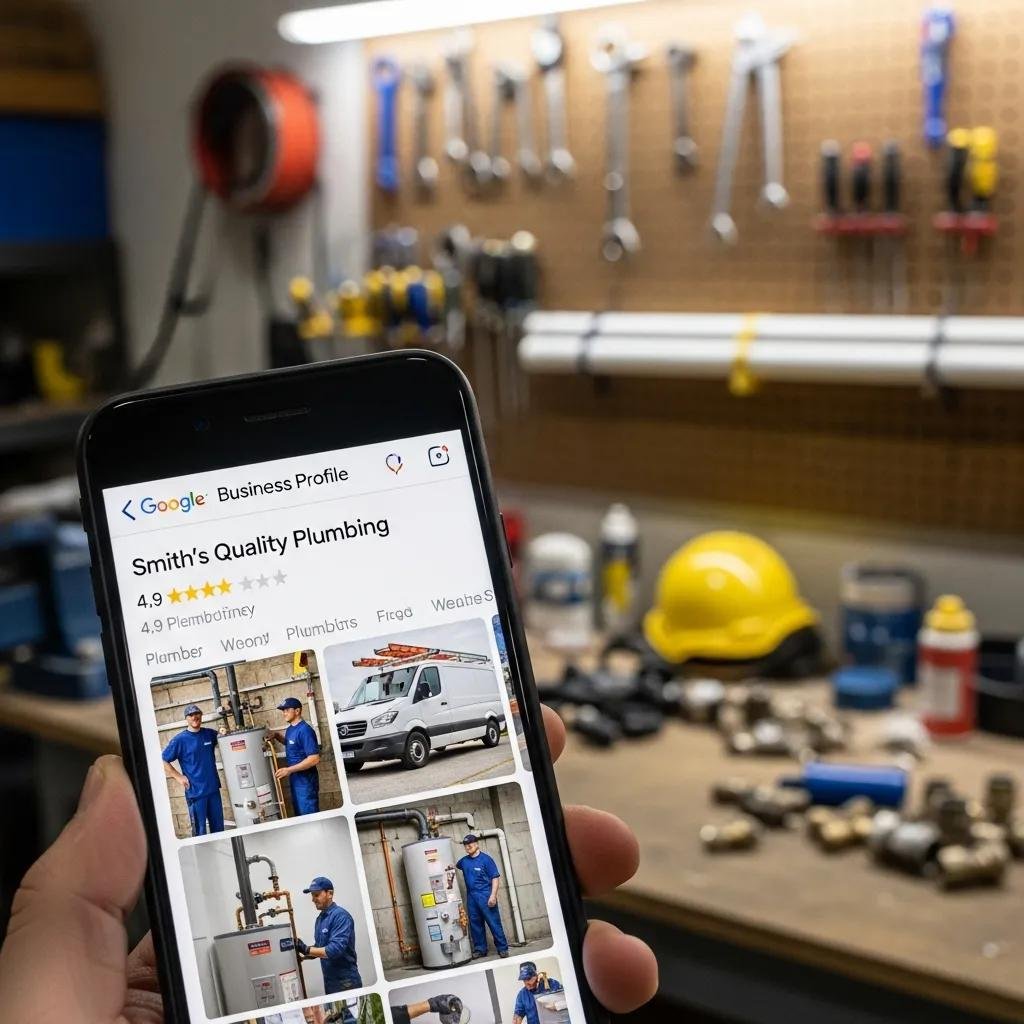
A fully optimized Google Business Profile (GBP) is the single most impactful tool for contractor visibility in local search because it feeds the local pack and Maps. The first priority is to claim and verify the profile, then complete every field with accurate, localized information and service descriptions that match user queries. High-quality photos, regularly posted updates, and a structured service list improve engagement and signal activity to Google; frequent, authentic reviews further amplify rankings and conversions. Use the service-area settings for trades that operate without a storefront, select primary and secondary categories that precisely match the trade (for example, “Plumber” or “Roofing contractor”), and include booking or call-to-action options when possible. Proper GBP optimization naturally ties to citation consistency and on-page content, as these combined signals reinforce the business’s local relevance and lead generation potential.
Research consistently underscores the critical role of a well-maintained Google Business Profile in enhancing local search visibility and connecting businesses with potential clients.
Google Business Profile Impact on Local Search & Visibility
This study focuses on how businesses could grow and show appear in local search results by using Google Business Profiles (GBPs). Before going to a store or using a service, a lot of people today perform a search on the internet, and Google Business Profile is crucial in helping local businesses connect with clients. The study examines how information such as a company’s location, contact information, hours of operation, website link, reviews, and images affect consumers’ choices. It also looks into how a company’s visibility on Google Maps and in local searches is enhanced by an active and updated profile.
A STUDY ON THE IMPACT OF GOOGLE BUSINESS PROFILE ON BUSINESS SUCCESS, B Sharma, 2025
Before the table below, here is a quick numbered checklist of the top steps to optimize GBP for contractors:
- Claim and verify the profile using the method available for your business model.
- Complete business name, accurate service-area settings, categories, and primary phone.
- Add detailed services, clear service descriptions, and booking or contact CTAs.
- Upload high-quality photos and update regularly; use descriptive filenames and ALT text.
- Solicit and respond to reviews, publish posts for promotions or seasonal services, and maintain Q&A.
| GBP Field | Recommended Attribute | Recommended Value / Tip |
|---|---|---|
| Primary Category | Category selection | Choose most-specific trade category (e.g., Plumber, Roofing contractor) |
| Services | Service list entries | List core services with short, local keyword–rich descriptions |
| Phone | Primary phone format | Use consistent local phone number (exact digits everywhere) |
| Service Area | Coverage | Define towns or zip prefixes served (avoid overly broad regions) |
| Photos | Photo types & count | Exterior, team, job photos, before/after; 10+ quality images recommended |
What Are the Steps to Set Up and Verify a Google Business Profile for Contractors?
To get started, create your Google Business Profile with the exact business name you operate under and provide the primary phone and service area details that reflect where you work. Verification methods depend on business type: many service-area contractors verify by postcard or phone, while some qualify for video verification or instant verification through an associated Google account; if a storefront exists, address verification applies. When setting up, choose the most accurate primary category and add secondary categories for niche services; then populate the services list with localized descriptions that mirror common search phrases. Troubleshoot common issues by ensuring that NAP formatting matches major directories, resolving duplicate profiles promptly, and using Google’s support channels for complex verification scenarios — these steps pave the way for an optimized public presence and make reviews and posts effective.
How to Manage Reviews, Photos, and Services on Your Google Business Profile?
Managing GBP content requires a predictable workflow: capture job photos on-site, tag them with context, and upload images regularly to maintain freshness; solicit reviews shortly after job completion using polite, compliant asks; and keep service descriptions updated for seasonal or new offerings. Photos should include clear before-and-after shots, team headshots, service vehicles, and finished work, each with descriptive filenames and ALT text that include service terms and location when appropriate. For reviews, implement a post-job follow-up process (email or SMS) that asks for feedback and includes simple instructions; respond to every review publicly with gratitude and a constructive tone for negatives, directing private resolution offline. When updating services, use concise, keyword-aware descriptions and include service-area qualifiers to reinforce local relevance. Consistent management of these GBP elements increases engagement, improves conversion rates, and signals active maintenance to search algorithms.
| Photo Type | Attribute | Recommended Count / Note |
|---|---|---|
| Before/After | Job context | 4–8 pairs to demonstrate work quality |
| Team & Crew | Trust signal | 3–5 images showing technicians and uniforms |
| Vehicles & Equipment | Branding | 2–4 images with visible company name or logo |
| Completed Projects | Portfolio | 8–12 high-quality images of finished jobs |
Photos that document work and personnel create trust and improve click-through from GBP listings. Regularly uploading diverse images helps maintain a dynamic profile and supports higher engagement from prospective customers.
At the end of GBP optimization, consider automation for repetitive GBP tasks such as posting, review reminders, and service updates. Platforms that specialize in AI-powered GBP automation can save time by streamlining these updates and ensuring consistency across listings, which is particularly useful for contractors managing multiple service areas.
Which Website SEO Techniques Enhance Local Search Marketing for Contractors?

On-site SEO for contractors should prioritize mobile-first usability, local keyword integration across service pages, and structured data that communicates services to search engines. Mobile responsiveness and fast loading are essential because a high percentage of local searches occur on mobile devices and users expect immediate click-to-call functionality. Content should include service-area pages that match common search intents (e.g., “emergency roof repair [city]”) and use title tags, headings, and meta descriptions that combine trade terms and geographies. Implementing Service and LocalBusiness schema helps search engines understand offerings and increases the chance of appearing in rich results. Together these techniques improve organic rankings and make website visitors more likely to contact the contractor after landing on a page.
Here is a checklist of core website optimizations every contractor site should implement:
- Responsive design and mobile-first layout with prominent CTAs.
- Local keyword mapping to individual service-area pages.
- Service and LocalBusiness schema markup on relevant pages.
- Fast page speed and optimized images to reduce load time.
- Clear contact points: click-to-call, request form, and booking options.
| Optimization | Attribute | Recommended Target / Tool |
|---|---|---|
| Mobile Speed | Target load time | Under 3 seconds on mobile; test with Lighthouse and PageSpeed Insights |
| Local Keyword Use | Placement | Titles, H1s, service pages, and meta descriptions with city modifiers |
| Schema Markup | Types | Use Service and LocalBusiness schema; test with structured data tools |
| Image Optimization | Format & size | Compress images, use modern formats (WebP) and responsive srcsets |
How to Implement Mobile-Friendly Design and Local Keyword Integration?
Mobile-first design begins with responsive templates, touch-friendly navigation, and CTAs above the fold that enable easy calling or booking. Prioritize a visible phone button, short contact forms, and fast-loading images to reduce friction for users who call from a job site or a job lead. For local keyword integration, map high-intent keywords to individual pages: main service pages for core offerings, and localized landing pages for each town or neighborhood served. Optimize titles and meta descriptions with trade and location terms, use H2s to structure service details, and include FAQ content that targets long-tail queries common in your service area. Ensure internal linking connects service-area pages to the main service hub, which distributes local relevance signals across the site.
What Is the Role of Schema Markup and Website Speed in Contractor SEO?
Schema markup and website speed directly affect how search engines interpret content and whether pages are eligible for enhanced search features. Service and LocalBusiness schema define relationships such as service types, service areas, and contact methods, allowing search engines to extract actionable data for rich results and voice assistants. Website speed improves user engagement metrics — lower bounce, higher interaction — and faster pages are more likely to rank well, especially on mobile. Recommended speed targets aim for under three seconds on mobile and high Lighthouse performance scores; use tools like Lighthouse, PageSpeed Insights, and real-user monitoring to measure improvements. Applying both schema and speed optimizations increases the likelihood of appearing in local packs and featured snippets, which directly boosts visibility and leads.
Further academic research supports the strategic importance of local optimization, particularly through Google Business Profile and structured data, for improving organic traffic and conversion rates.
Local SEO Optimization with Google My Business & Schema Markup
The Purpose of the presented research is to substantiate the importance of the local optimization of the retailer’s business for search engines to increase organic traffic; to represent insights and give practical recommendations for retailers regarding local optimization of their business in Google as part of an effective marketing strategy; to create the typical valid data micromarking (by the example of the Ukrainian retailer), which will contribute to an advantageous placement in the Local Pack in comparison with competitors, and increase organic traffic and conversion.Methods. To achieve the purpose, the system of general and special research methods are used, including the logical generalization, analysis, comparison and synthesis. To formulate recommendations for retailers, the following online tools are used: Google My Business (to study the specifics of profile), JSON-LD Generator (to generate the data micromarking), Google Structured Data Testing Tool (to verify the validity of data micromarking).
Business optimization in the digital age: Insights and recommendations, A Natorina, 2020
How Can Contractors Effectively Manage Online Reputation and Reviews?
A systematic reputation strategy helps contractors earn more 5-star reviews, manage responses efficiently, and leverage social proof across web properties to strengthen local rankings. Reputation management includes proactive review solicitation after job completion, monitoring review platforms consistently, and archiving positive feedback for use in marketing materials and website content. Responses to reviews should follow templates that express thanks, summarize the service provided, and, for negative feedback, offer next steps for resolution offline. Using review data in structured snippets and testimonial pages amplifies trust for prospective customers and reinforces relevance signals for local search. Reputation workflows directly tie into GBP management and on-site content, creating a virtuous cycle that improves both conversions and rankings.
Below is a three-step list that lays out the core reputation workflow contractors should adopt.
- Ask: Solicit reviews promptly after job completion using a brief, compliant request.
- Respond: Reply to every review with gratitude or a resolution plan, keeping responses concise and professional.
- Leverage: Surface positive reviews on the website and in marketing materials and use review insights to improve service pages.
What Strategies Help Contractors Earn and Leverage 5-Star Reviews?
Timing and ease are critical when asking for reviews: request feedback within 24–72 hours after completing a job while the experience is fresh and offer clear, simple instructions for where to leave a review. Use SMS or email templates that are short, polite, and include a thank-you that frames the request as valuable feedback rather than a demand. Automate follow-ups where possible to maintain consistency without manual effort. Ethically, avoid incentivizing reviews and never pressure customers to change negative feedback; instead, invite constructive dialogue to resolve issues. Once received, leverage top reviews by adding them to service pages, Google posts, and case-study snippets, and mark up testimonials with Review schema to increase chances of showing review snippets in search results.
How Should Contractors Respond to Positive and Negative Customer Feedback?
Responses should be prompt, professional, and tailored: thank the reviewer and mention the specific service for positive feedback, and for negative feedback acknowledge the problem, apologize for the experience, and offer a private channel to resolve the issue. Example response frameworks include a short expression of gratitude, a sentence reinforcing how you prioritize quality, and an invitation to contact the office to make things right. For complicated disputes, escalate internally with a documented timeline of remedies and keep public replies focused on empathy and problem-solving without disclosing private details. Public, well-handled responses signal professionalism to prospective customers and can mitigate the impact of negative reviews on conversion rates.
What Are Niche-Specific Local SEO Strategies for Plumbers, Electricians, and Roofers?
Different trades require tailored keyword focus, content formats, and reputation cues because of varying search intents and emergency profiles. Plumbers often target emergency and appointment-based queries and should emphasize “emergency” and “same-day” phrases, while electricians benefit from safety and certification content that demonstrates expertise and trust. Roofers should prioritize seasonal and event-driven content, such as storm damage landing pages and insurance-handling guides. Across all trades, local case studies, permit and licensing mentions, and clear before-and-after galleries increase conversions and local authority. Crafting trade-specific content aligned with these intents helps contractors capture high-intent searches and presents relevant trust signals to both users and search engines.
Here is a bulleted list of trade-specific content ideas to implement:
- Plumbers: Emergency pages, fixture-specific guides, drain cleaning FAQs.
- Electricians: Safety certifications, EV charger installation pages, permit guides.
- Roofers: Storm response pages, insurance claim process content, roofing material comparisons.
How to Target Plumbing Keywords and Emergency Services for Plumbers?
Plumbers should build pages that match urgent search intents, such as “burst pipe repair near me” or “24/7 emergency plumbing [city],” and include clear click-to-call CTAs and availability indicators. Use schema types that emphasize service offerings and emergency availability where applicable, and create short, descriptive landing pages for each common emergency scenario with advice, approximate response windows, and call prompts. GBP posts and service updates should reflect emergency availability and seasonal issues (e.g., freeze prevention), and images of emergency repairs can build trust. Reputation signals are crucial for emergency work — volume and recency of positive reviews elevate a plumber’s likelihood of selection when time is critical.
What Are Effective Local SEO Tactics for Electricians and Roofing Contractors?
Electricians should showcase qualifications, licensing details, and safety standards on service pages and FAQ sections to address trust-related queries; content that explains wiring code, inspection processes, and certification adds authority. Roofers should create event-responsive content such as storm-damage checklists, temporary tarp services, and insurance claim guidance that align with spikes in local search during severe weather. Both trades benefit from local backlink opportunities: supplier partnerships, contractor associations, and local news stories about completed work or community involvement. Timely, localized content combined with authoritative backlinks and robust GBP entries positions electricians and roofers for both organic and maps-based discovery during demand surges.
How Does AI-Powered SEO, Like the OTTO Platform, Transform Local SEO for Contractors?
AI-powered platforms accelerate routine SEO tasks and scale local optimization workflows for multi-location or multi-service contractors by automating keyword discovery, on-page suggestions, and GBP updates. The core benefit is time-savings: AI can analyze search intent at scale, propose optimized page copy, and identify citation inconsistencies that would otherwise require manual audits. These automated outputs do not replace human strategy but augment it by handling bulk operations and surfacing high-priority opportunities faster. For contractors with limited marketing resources, AI-driven automation reduces manual labor and allows teams to focus on high-impact actions like customer service and project delivery.
The following numbered list outlines where AI automation typically adds value for contractor SEO:
- Bulk keyword discovery and local intent clustering for service-area pages.
- Automated on-page optimization suggestions including title and meta rewrites.
- GBP task automation such as posting, review prompts, and service updates.
These capabilities accelerate execution and ensure consistent implementation across many listings and pages. Next we explore specific AI-driven benefits for keyword research and content optimization.
What Are the Benefits of AI Automation in Keyword Research and Content Optimization?
AI speeds up keyword discovery by processing large volumes of query data and grouping long-tail, location-specific intents that matter to contractors, enabling efficient mapping of queries to dedicated landing pages. For content optimization, AI provides on-page suggestions — headings, keyword density, and schema recommendations — that align pages with local search patterns. AI also assists with content gap analysis, highlighting missing service pages or FAQ topics based on competitor signals and regional search behavior. A practical workflow is to run AI keyword clustering, generate page outlines for the most valuable clusters, and then review and edit outputs to maintain brand voice and technical accuracy. This hybrid approach leverages the speed of AI with the judgment of human experts.
Studies confirm that AI-driven tools significantly streamline SEO tasks, including keyword generation and content creation, leading to improved search engine rankings and visibility.
AI-Driven SEO for Keyword Generation & Content Optimization
This study adopts the descriptive research method to design an innovative SEO marketing plan aimed at promoting Indonesian tourism using AI-driven tools, specifically SEO.AI. The objective is to explore how artificial intelligence can be leveraged for enhancing keyword generation, content creation, and overall SEO optimization to boost the visibility of Indonesian destinations on global search engines. The research identifies high-volume tourism-related keywords likeBali,Komodo Island, andRaja Ampatand develops a step-by-step SEO strategy, including AI-powered content generation, website optimization, and link-building techniques. Through this process, the study demonstrates the effectiveness of AI-driven tools in streamlining SEO tasks and improving search engine rankings, providing practical implications for the tourism industry.
Designing an innovative SEO marketing plan to promote Indonesian tourism using AI-driven tool, S Marpuah, 2024
How Has OTTO AI Helped Contractors Achieve Measurable Local SEO Success?
As an AI-driven offering operating under the OTTO AI-Powered SEO brand, OTTO automates routine on-page tasks, speeds up bulk optimizations, and helps craft Raleigh-specific strategies that boost Google Business Profile dominance and web page rankings. SEORaleigh highlights that OTTO can dramatically reduce manual labor and save countless hours by providing automated suggestions for instant webpage optimizations and GBP actions; these automation features let contractors focus on operations while maintaining consistent local SEO execution. For contractors exploring AI augmentation, requesting a demo or a free analysis can show how automation integrates with existing workflows and what types of improvements — such as increased GBP activity or broader service-page coverage — are achievable without reassigning internal staff.
This H3 intentionally connects product-level benefits to practical contractor outcomes while maintaining a focus on topic-first education. The next major section addresses citations and link building, the off-site signals that reinforce local authority.
Which Local Citation and Link Building Practices Boost Contractor Online Visibility?
Citations and local backlinks confirm a contractor’s existence and relevance to search engines, so maintaining NAP consistency and pursuing authoritative local links are core tasks. Conduct a citation audit to find inconsistent entries and prioritize corrections on high-impact directories such as major local business directories, trade association listings, and relevant industry platforms. For backlinks, target local news coverage, supplier pages, community sponsorships, and trade associations that provide contextual, location-relevant links. A combined citation and backlink strategy strengthens the business entity signal that search engines use to rank contractors in the local pack and improves the overall domain authority for service pages.
Before the table, here is a short bulleted list of citation sources to prioritize:
- Major local directories and chamber of commerce pages.
- Trade association and supplier partner listings.
- Local news stories and community sponsorship pages.
| Directory / Source | Authority Attribute | Consistency Checklist |
|---|---|---|
| Local Chamber | High local relevance | Ensure NAP exact match and correct category |
| Industry Association | Trade authority | List certifications/licenses if allowed |
| Local News / Press | Local credibility | Use press release or project feature with consistent NAP |
Why Is NAP Consistency Important Across Local Directories and Listings?
NAP consistency matters because search engines consolidate signals from multiple sources to build an authoritative entity record for a business; inconsistent phone numbers or business names can fragment that record and reduce local ranking strength. Run an audit that compares the GBP entry to top directories, correct any differences, and document canonical formatting for use across all platforms. Tools can speed the cleanup, but manual verification for high-priority listings ensures fidelity. Prioritizing directories with greater local authority yields the most immediate benefit, while a consistent NAP across many smaller citations reinforces the same entity signal over time.
How to Build Quality Backlinks Relevant to Contractor Services?
Quality backlinks arise from local partnerships, supplier relationships, sponsorships, and content-driven outreach such as project case studies that local news outlets or trade blogs will reference. Create shareable assets like roofing storm-response checklists, electrical safety guides, or plumbing maintenance calendars and pitch them to local organizations, housing associations, and suppliers. Offer to guest-author safety or maintenance columns for community newsletters and get listed on supplier partner pages. When outreaching, use contextual anchor text that complements local keywords (e.g., “[city] roof repair” or “licensed electrician in [county]”) and track outreach outcomes to replicate successful approaches.
This set of outreach tactics completes the off-site layer of local SEO; the final article section answers common contractor questions and tactical next steps.
What Are Frequently Asked Questions About Local SEO for Contractors?
How Do Contractors Get More Local Leads Through SEO?
Contractors get more local leads by focusing on three core areas: an optimized Google Business Profile that drives maps visibility and click-to-call actions; targeted local landing pages and service-area content that match searcher intent; and reputation management that increases trust through recent, positive reviews. Consistent citations and relevant backlinks further amplify visibility. These combined actions create multiple discovery pathways — maps, organic results, and review-driven impressions — that convert searches into inbound contacts.
What Is the Best Way to Improve Google Maps Ranking for Contractors?
The most effective actions to improve Google Maps ranking are ensuring GBP completeness and accurate primary category selection, increasing the volume and recency of positive reviews, and optimizing on-site pages with local keywords and schema to improve relevance. Maintain consistent NAP across directories and pursue relevant local backlinks to strengthen the entity signal. Regular GBP activity, such as posts and new photos, signals ongoing relevance and can improve local pack performance.
- Complete GBP: All fields and services filled accurately.
- Earn reviews: Systematically solicit and respond to customer feedback.
- On-site relevance: Local pages with schema and fast performance.
Additional Practical Checklist for Local SEO Implementation
Before closing the FAQ section, implement this concise checklist to operationalize local SEO efforts:
- Verify and fully optimize Google Business Profile fields.
- Publish service-area pages for each major town you serve.
- Run a citation audit and correct NAP inconsistencies.
- Create a simple reputation workflow for review requests and responses.
- Use schema markup for Service and LocalBusiness on relevant pages.
Final note on next steps and assistance
For contractors seeking an automated way to scale these local SEO tasks, platforms branded under OTTO AI-Powered SEO by SEORaleigh offer automation for on-page optimizations and GBP maintenance that can dramatically reduce manual effort while preserving strategic oversight. Requesting a demo or free analysis can illustrate how automation applies to your specific service areas and workflows without requiring internal reorganization.