SEO Services in Wake Forest NC: AI-Powered Local SEO Solutions
Boost Visibility with AI-Powered Local SEO in Wake Forest, NC
AI-powered local SEO uses machine learning and automation to detect local intent, optimize location signals, and scale optimizations so Wake Forest businesses appear for high-value searches in Maps and local results. This article explains how AI changes the mechanics of local search — from hyperlocal keyword discovery to Google Business Profile (GBP) optimization — and why Wake Forest companies should adopt AI-driven workflows to convert local visibility into measurable leads. Readers will learn the core technologies behind AI local SEO, practical techniques for GBP and content, and how to evaluate vendor offerings with an emphasis on transparent, local-first execution. We’ll also show how an agency-assisted AI service can be applied in Wake Forest contexts, outline best practices for technical SEO and link building, and summarize the kinds of KPIs local businesses should track. Expect tactical lists, concise EAV comparison tables, and step-by-step workflows you can apply directly to Wake Forest local search marketing.
What Is AI-Powered Local SEO and Why Does It Matter for Wake Forest Businesses?
AI-powered local SEO is the use of machine learning models, natural language processing, and automation to analyze local search behavior, generate optimized content, and manage local signals at scale. By synthesizing SERP patterns, Google Business Profile data, and on-site signals, AI reduces manual guesswork and speeds up iterations that traditionally took weeks into hours. For Wake Forest companies, this means faster detection of neighborhood-level trends, prioritized fixes for mobile-first local queries, and automated GBP updates that keep business information fresh for local searchers. The next paragraphs break down concrete differences between automated platforms and manual workflows, showing how speed, scale, and personalization translate into measurable local visibility gains.
AI-driven platforms outperform manual workflows on throughput, consistency, and pattern recognition, especially when managing multiple service pages, locations, or seasonal campaigns. Below is a compact comparison that highlights how an AI approach maps to common local SEO attributes versus manual processes.
| Approach | Attribute | Benefit |
|---|---|---|
| AI-assisted automation (OTTO-style) | Scale and speed | Enables thousands of page optimizations and rapid GBP updates |
| Human/manual workflows | Contextual judgment | Deep local knowledge and nuanced brand voice control |
| Hybrid (agency-assisted AI) | Personalization with oversight | Combines automation efficiency with human review to protect brand E-E-A-T |
This table shows why many local strategies move toward a hybrid model that couples automation with human verification. The following subsection explains the mechanisms AI uses to enhance local SEO workflows.
How Does AI Enhance Local SEO Strategies in Wake Forest?
AI enhances local SEO by aggregating signals across SERP features, GBP insights, searcher intent, and website telemetry to recommend prioritized actions that align with local intent. Models classify queries by intent and surface neighborhood or event-driven keywords, then map them to pages or new GBP posts that meet user needs. In practice, AI can detect spikes in “Wake Forest plumber open now” or “best pizza near Highway 1” and trigger content drafts, meta updates, or GBP post suggestions. This pattern detection shortens the feedback loop between query trends and on-site content, enabling Wake Forest businesses to be first when local demand emerges.
AI also supports personalization and predictive prioritization by scoring pages and GBP items according to likely impact, which reduces wasted effort on low-value tasks and focuses teams on actions that drive calls, directions, and bookings. That prioritization naturally leads into the specific business benefits AI unlocks for local companies.
What Are the Key Benefits of AI-Driven Local SEO for Wake Forest Companies?

AI-driven local SEO delivers measurable improvements that matter to Wake Forest business owners: faster updates, scalable content creation, improved GBP management, and data-driven prioritization of high-impact tasks. These benefits translate to increased local visibility, higher placement in the Local Pack, and more direct customer actions such as calls and direction requests. Below is a concise list of the top benefits local companies should expect when adopting AI-enhanced workflows.
- Speed to market: Automated detections and optimizations reduce reaction time from trend discovery to live changes.
- Scale without quality loss: Consistent on-page and GBP updates across many local pages maintain signal uniformity.
- Precision prioritization: Machine scoring focuses resources on tasks with the highest likely ROI.
These benefits are especially useful for competitive Wake Forest niches where local intent and timing determine whether a searcher converts to a customer.
How Does SEORaleigh’s OTTO AI Platform Revolutionize Local SEO in Wake Forest?
SEORaleigh leverages an agency-assisted OTTO AI approach to combine local SEO expertise with automated workflows that accelerate local visibility improvements for Wake Forest clients. The OTTO Agency Assisted SEO model integrates AI-powered on-page automation with human strategy, which allows local practitioners to maintain brand control while benefiting from rapid optimizations. SEORaleigh positions this offering as a local-first implementation, pairing automated capabilities with agency oversight to ensure changes reflect Wake Forest market nuances. The next subsections describe OTTO’s features and how the Search Atlas partnership supports ongoing monitoring and client transparency.
What Features Does OTTO Offer for Wake Forest Local SEO Optimization?
OTTO provides automated on-page SEO tasks, topical mapping, dynamic indexing suggestions, and tools designed to improve visibility in both standard and AI-driven search engines. In Wake Forest contexts, these features help create location-focused topical maps, generate metadata variations for neighborhood pages, and suggest schema markup tailored to local services. The platform’s automation reduces repetitive work — for example, bulk metadata updates and structured data generation — while agency specialists review outputs for local relevancy and brand voice. By combining automated content scaffolds with human editing, OTTO accelerates page creation and optimization without sacrificing local fidelity or E-E-A-T considerations.
These automated features free local teams to focus on higher-value tasks such as customer experience and community outreach, which in turn support link-building and citation strategies described later.
How Does the Partnership with Search Atlas Enhance AI SEO Solutions?
The partnership with Search Atlas gives SEORaleigh access to OTTO’s dashboards and continuous platform updates, enabling real-time visibility into optimization recommendations and performance metrics. This arrangement separates platform capability from local implementation: OTTO supplies automation and reporting, while SEORaleigh applies local strategy, human review, and execution tailored to Wake Forest markets. Clients benefit from platform-driven scale combined with agency-guided prioritization, ensuring that automated suggestions are aligned with local business goals and brand voice. The platform partnership also facilitates iterative improvement by feeding performance data back into models for more accurate local recommendations.
That transparent feedback loop allows Wake Forest businesses to see which actions drive GBP interactions and local rankings, informing the GBP techniques discussed in the next section.
Which AI-Powered Techniques Improve Google Business Profile Rankings in Wake Forest?
AI improves Google Business Profile rankings by automating content cadence, analyzing sentiment in reviews, and recommending GBP attribute and category adjustments based on local search patterns. These techniques ensure GBP signals remain relevant and complete, which is essential for Local Pack placement. Below is a short, direct list of high-impact AI techniques that map to GBP outcomes and local visibility improvements.
- Automated GBP content scheduling: Keeps posts and offers fresh to signal activity.
- Review monitoring and sentiment analysis: Enables fast, contextual responses to customer feedback.
- Category and attribute recommendations: Aligns profile fields with queries driving local demand.
These automated techniques work together to increase engagement metrics and improve the likelihood of appearing in Maps and the Local Pack.
| Technique | Automated Task | Benefit/Impact |
|---|---|---|
| Review analysis | Sentiment detection and draft replies | Faster responses and improved customer engagement |
| Content scheduling | Timed posts and offers | Increased profile interactions and freshness signals |
| Attribute tuning | Category and attributes suggestions | Better match for query relevance and local intent |
This table shows how automations can be prioritized to lift the most impactful GBP signals. The following subsection explains a typical automation workflow for managing reviews while preserving brand voice.
How Does AI Automate Google Business Profile Management and Review Responses?
AI automates GBP management by detecting new reviews, classifying sentiment, and suggesting templated replies that maintain a local brand voice while allowing a human to approve or edit responses. A typical flow detects a negative review, flags it for immediate attention, generates a context-aware draft reply, and presents escalation options if the issue requires service recovery. For positive reviews, the system suggests personalized thank-you messages that reference recent purchases or services. This human-in-the-loop approach balances speed with authenticity and protects E-E-A-T signals while ensuring consistent responsiveness.
Automated GBP monitoring also collects engagement insights that inform posting cadence and attribute adjustments, which leads to practical optimization priorities covered next.
Why Is Google Business Profile Optimization Crucial for Wake Forest Local SEO?
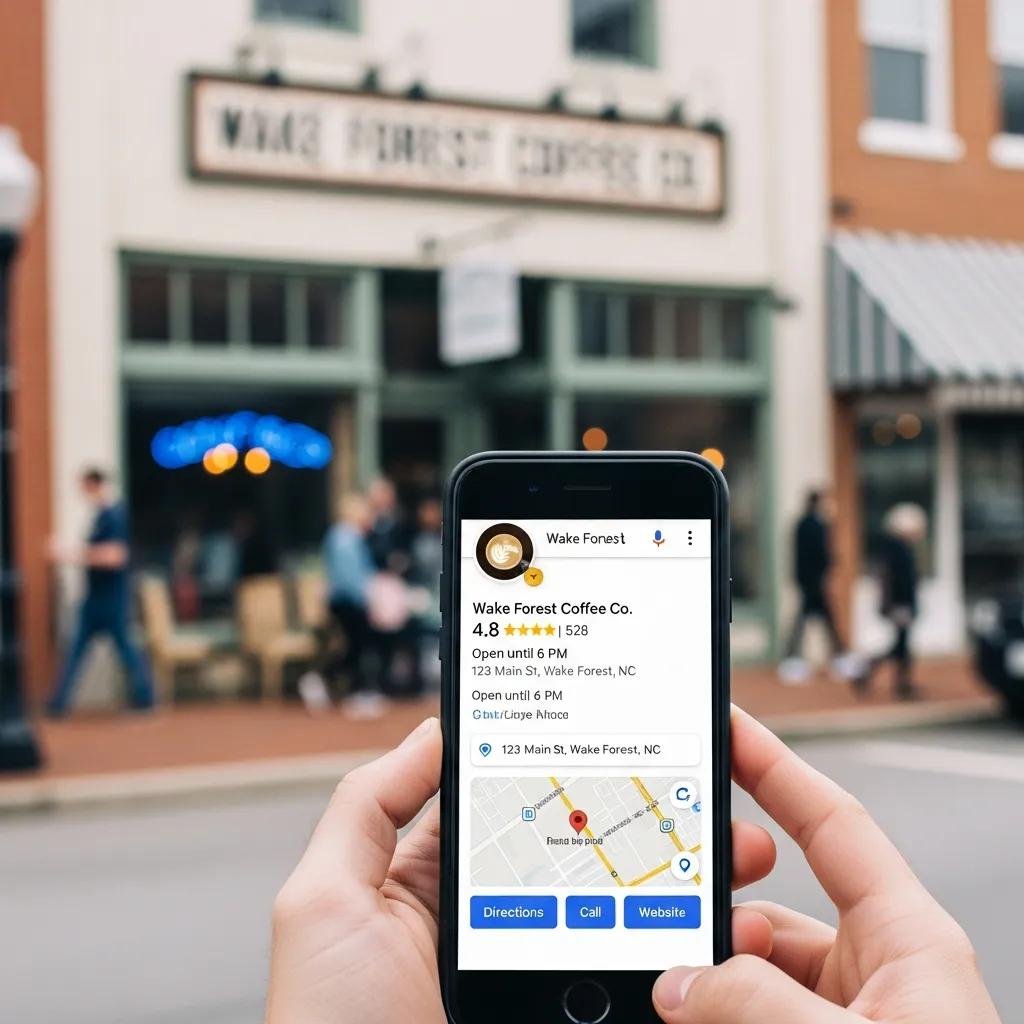
Google Business Profile is crucial because it directly influences how often a business appears in the Local Pack, how many users see key contact actions, and whether searchers convert to calls, visits, or directions. Optimized categories, attributes, photos, and timely posts are strong trust signals that increase click-through and interaction rates for Wake Forest queries. Local consumers often use Maps for immediate decisions, so a complete, active GBP reduces friction and increases conversions from local searches. The next section outlines the highest-priority GBP items Wake Forest businesses should maintain to maximize discovery and engagement.
Key GBP optimization priorities include categories, attributes, posts, photos, and Q&A management:
- Primary category accuracy: Ensures queries match the business’s core offering.
- Attribute completion: Reflects services and amenities that matter to local searchers.
- Regular photo and post updates: Signals activity and encourages clicks.
Maintaining these priorities improves local discovery and feeds data back into AI models for continued performance tuning.
How Can Wake Forest Businesses Leverage AI for Keyword Research and Content Strategy?
AI supports hyperlocal keyword discovery by combining SERP analysis, GBP search queries, and site search logs to surface neighborhood-level long-tail phrases and event-driven queries. This capability enables Wake Forest businesses to create focused landing pages and GBP posts for specific neighborhoods, seasonal events, or micro-intents, improving relevance for local queries. The procedural approach below outlines a concise method for using AI to translate discovery into targeted content that resonates locally and converts.
Use this three-step approach to build a hyperlocal content strategy:
- Discover: Use AI to aggregate local query clusters from SERP features, GBP insights, and behavioral data.
- Cluster & Prioritize: Group keywords by intent and estimated local impact, then prioritize by conversion potential.
- Humanize & Publish: Turn AI drafts into locally resonant pages and GBP posts with neighborhood specifics and customer stories.
Following these steps helps ensure AI discovery leads to content that matches local intent and preserves brand authenticity.
What Role Does AI Play in Hyperlocal Keyword Discovery for Wake Forest?
AI uncovers hyperlocal keyword opportunities by identifying query modifiers tied to neighborhoods, landmarks, seasonal events, and competitor gaps that manual audits often miss. Models can surface clusters like “Wake Forest pediatric dentist near [neighborhood]” or event-specific queries during local festivals. AI also estimates relative opportunity by combining search volume signals with GBP interactions to prioritize clusters likely to drive visits and calls. This clustering enables scale: instead of manually brainstorming dozens of local pages, AI generates candidate topics that a human editor converts into localized content.
These hyperlocal clusters then feed into the content templates and editorial checklists that make AI drafts perform better for local audiences.
How Does AI Help Craft Location-Optimized Content That Resonates Locally?
AI accelerates content production by creating drafts and topical outlines that include local phrases and suggested schema, but the highest-performing pages are those humans localize with specific details like neighborhood landmarks, local testimonials, and service nuances. A practical checklist for localizing AI drafts includes adding: precise service-area descriptions, recent local references or events, customer quotes or paraphrased reviews, and localized structured data.
Research further emphasizes the critical role of human oversight in refining AI-generated content for accuracy and local relevance.
Generative AI in Content SEO: Use Cases, Benefits & Pitfalls
This paper studies the use cases, benefits, pitfalls, team role implications, organisational success factors and organisational barriers for generative AI in content SEO work. The findings come from ten interviews with Finnish SEOs and content creators. Main findings were that AI use is still largely unstructured and individually driven. While AI text was perceived to be good enough for specific use cases, human edits and revisions were still needed in most cases. AI text fluffiness, factual errors, incorrect tone and mistrust in Google’s guidelines all made human edits necessary.
Generative AI in content SEO processes, 2024
By combining AI speed with a human editing pass focused on local signals, Wake Forest businesses achieve both scale and authenticity in their content strategy.
This humanization step preserves E-E-A-T and ensures that AI-generated content reads like a local business rather than a generic page, which supports conversions.
What Are the Best Practices for AI-Driven Technical SEO and Local Link Building in Wake Forest?
AI-driven technical SEO focuses on automated audits, schema generation, and indexing signals that remove common barriers to local discovery. For local link building, AI helps prospect local citation sources, scores opportunity relevance, and drafts personalized outreach templates that a human can refine before sending. The combined technical and link-building approach reduces manual overhead and identifies the highest-impact technical fixes and outreach targets for Wake Forest sites. Below is a practical checklist of best practices and a compact EAV table clarifying AI actions and expected results.
Implement these best practices to secure a strong technical foundation and local link profile:
- Automated technical audits: Run regular checks for mobile, speed, and indexability issues and prioritize fixes.
- Schema and localBusiness markup: Use AI to create and validate structured data for services and locations.
- Prospect local links with scoring: Let AI score targets by relevance and authority, then apply human outreach for relationship building.
These practices ensure technical health and local authority signals remain in sync with on-page and GBP optimizations.
| Technical Area | AI Action | Expected Result |
|---|---|---|
| Page speed | Automated diagnostics and prioritized fixes | Faster load times and improved mobile ranking signals |
| Schema markup | Generate and validate localBusiness structured data | Improved indexing and enhanced SERP features |
| Indexing | Dynamic indexing recommendations | Faster discovery of updated pages and new local pages |
This table clarifies how automation maps to technical outcomes that improve local search performance. The next subsection details which on-page tasks are safe to automate and which require human oversight.
How Does AI Automate On-Page and Technical SEO Tasks for Wake Forest Websites?
AI automates repetitive on-page tasks such as meta title and description variations, internal linking suggestions, and schema generation while flagging items that require human judgment, like brand messaging or complex content merges. For local sites, priority automation targets are mobile optimization, critical CSS suggestions, and schema for service-area businesses. AI can produce candidate titles and schema snippets that an editor reviews and approves, significantly speeding up rollout across multiple service pages. The safe automation-plus-review model reduces risk while delivering consistent on-page signals across a local site.
This approach balances speed and quality, and it naturally connects to how AI assists in local link prospecting and outreach.
How Can AI Identify and Manage Local Link Building and Citation Opportunities?
AI identifies local link and citation prospects by analyzing local directories, community sites, event pages, and competitor backlink profiles, then scoring opportunities by relevance, authority, and conversion potential. After scoring, AI can draft outreach templates and follow-up sequences that a human personalizes and sends to target contacts, enabling scale without sacrificing relationship-building. A simple scoring model might weight local relevance highest, followed by topical authority and traffic potential. Human reviewers should handle relationship-sensitive conversations and partnerships to secure meaningful, sustainable links.
Balancing automated prospecting with human outreach safeguards long-term local partnerships and ensures link-building preserves brand integrity.
What Success Stories Demonstrate the Impact of AI-Powered Local SEO in Wake Forest?
AI-powered local SEO projects typically deliver improvements across local organic visibility, Google Business Profile interactions, and conversion-focused metrics such as direction requests or calls. Wake Forest businesses that adopt hybrid AI workflows often see faster discovery of local demand, more frequent GBP interactions, and cleaner technical foundations that support rankings. Below are categories of businesses that commonly benefit and the kinds of tactics used to produce measurable outcomes.
Local business categories that gain from AI-local SEO include:
- Restaurants and cafes: Use GBP post cadence and hyperlocal menu pages to capture event-driven searches.
- Real estate and local agents: Leverage neighborhood pages and schema to appear for specific community queries.
- Professional services (plumbers, lawyers, clinics): Prioritize GBP completeness, reviews, and service-area pages to drive calls.
These examples show how tactical combinations of GBP work, hyperlocal pages, and technical fixes generate outcomes that matter to local owners.
Which Wake Forest Businesses Have Thrived Using SEORaleigh’s AI SEO Solutions?
Several types of Wake Forest businesses benefit from a combined AI-and-agency approach: restaurants that need rapid menu and event updates, realtors promoting neighborhood pages, and service providers who must maintain accurate GBP information across shifts in hours or services. SEORaleigh’s OTTO Agency Assisted SEO model and the partnership with Search Atlas enable these business types to scale updates and surface opportunities faster than manual workflows alone. The agency-led implementation ensures AI recommendations are localized, vetted, and aligned with each business’s customer experience goals.
These implementation patterns lead directly into measurable KPIs and expectations discussed next, which help set realistic timelines for local outcomes.
What Measurable Results Can Wake Forest Companies Expect from AI Local SEO?
Wake Forest companies adopting AI-powered local SEO should track KPIs such as Local Pack rankings, GBP interactions (calls, direction requests, messages), organic local traffic to service-area pages, and lead conversions. Improvements are typically visible in weeks for GBP engagement and within a few months for sustained organic ranking lifts, depending on competition and resource allocation. Regular measurement and iteration are essential; AI accelerates hypothesis testing, but consistent monitoring ensures that models and human editors refine priorities over time. For businesses curious about specific opportunities, SEORaleigh offers a Free Website Analysis to identify immediate local optimization wins and outline a practical roadmap tailored to Wake Forest market signals.
Requesting a Free Website Analysis is a way to obtain a localized audit and prioritized next steps that combine AI-driven insights with human strategy to address Wake Forest-specific search behavior.