Affordable AI SEO Services for Small Businesses

Affordable AI SEO Services to Boost Local Visibility & Generate Leads
Affordable AI SEO services combine automated optimization, local intent targeting, and streamlined content workflows to deliver measurable visibility and lead-generation for small businesses. These services use machine learning and rule-based automation to handle repetitive SEO tasks—like Google Business Profile updates, local keyword research, and on-page optimization—so small teams can compete for local search traffic without large budgets. This article explains what affordable AI SEO services are, how AI-driven platforms enhance local rankings and lead volume, and practical ways small businesses can evaluate pricing and ROI. You will get a step-by-step view of core mechanisms (GBP automation, content clustering, structured data), guidance on tool selection, pricing comparisons with expected outcomes, and a local case study that illustrates results. Throughout, the focus is on actionable tactics small business owners and contractors can apply to capture local pack visibility and generate consistent leads, with examples oriented to Raleigh, North Carolina.
What Are Affordable AI SEO Services and How Do They Benefit Small Businesses?
Affordable AI SEO services are subscription or managed offerings that apply AI automation to local search tasks, lowering cost and time barriers for small-business SEO. They work by automating repetitive work—keyword discovery, content brief generation, on-page tagging, and Google Business Profile (GBP) maintenance—so owners and small teams can scale visibility without hiring large agencies. The result is faster execution, improved local relevance, and more reliable GBP signals that help businesses appear in local pack results. Small businesses typically benefit through reduced hourly cost, better local targeting, and predictable reporting that ties optimization actions to lead metrics.
The importance of local optimization for businesses, particularly in achieving prominent placement in Google’s Local Pack and boosting organic traffic, is further underscored by academic research.
Local SEO for Retailers: Boosting Organic Traffic & Google Local Pack
The Purpose of the presented research is to substantiate the importance of the local optimization of the retailer’s business for search engines to increase organic traffic; to represent insights and give practical recommendations for retailers regarding local optimization of their business in Google as part of an effective marketing strategy; to create the typical valid data micromarking (by the example of the Ukrainian retailer), which will contribute to an advantageous placement in the Local Pack in comparison with competitors, and increase organic traffic and conversion.
Business optimization in the digital age: Insights and recommendations, A Natorina, 2020
The next section defines core AI SEO components so you can see which tasks automation handles and how that reduces operational friction.
Defining AI SEO Services for Small Business Growth
AI SEO services bundle several capabilities that together accelerate local discoverability for small businesses. At their core these services include automated local keyword research, AI-generated content briefs tailored to intent clusters, on-page optimization applied at scale, and GBP optimization routines that keep business profiles fresh. For example, AI can scan search volumes and competitor signals to produce a prioritized keyword cluster and then generate a landing-page brief with headings, meta guidance, and schema recommendations—reducing the time from topic to publish. This automated pipeline reduces manual labor and lets small teams focus on customer service and conversion optimization. Understanding these components clarifies which capabilities matter most when you evaluate affordability and expected outcomes.
Key Benefits of AI-Powered SEO for Local Small Businesses
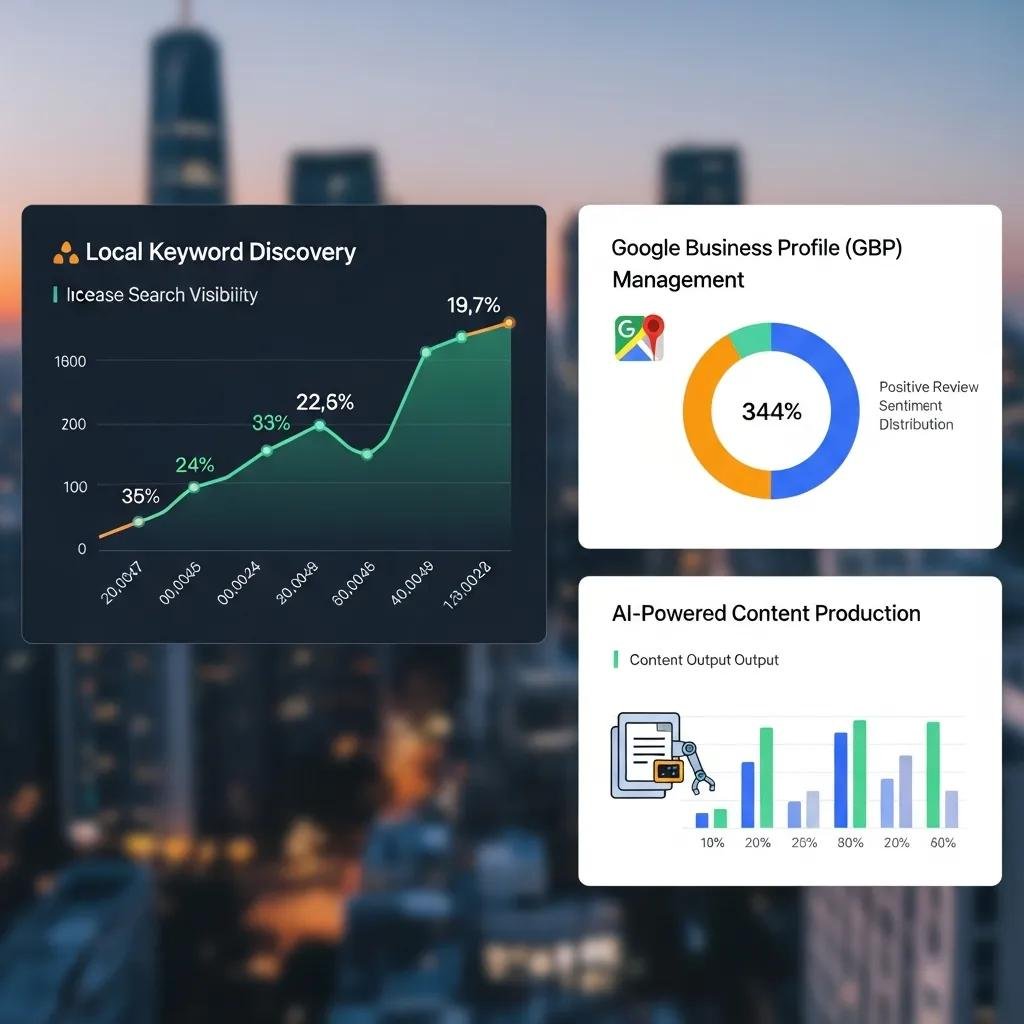
AI-powered SEO delivers several practical benefits that small and local businesses can measure and act on.
- Faster Local Keyword Discovery: AI identifies intent-driven keyword clusters relevant to neighborhoods and service areas.
- Consistent GBP Management: Automated scheduling of posts, Q&A updates, and attribute checks increases profile activity and signals.
- Lower Operational Cost: Automation reduces billable hours required for research, tagging, and iterative content updates.
- Scalable Content Production: AI content briefs and templates speed page creation while maintaining local relevance.
These advantages translate into clearer action plans: higher GBP impressions, more locally targeted pages, and lower cost per published page. In the next section, we examine a real-world AI platform that applies these mechanisms to Raleigh businesses and how it automates GBP and localized content workflows.
How Does OTTO AI-Powered SEO Enhance Local SEO for Small Businesses in Raleigh?
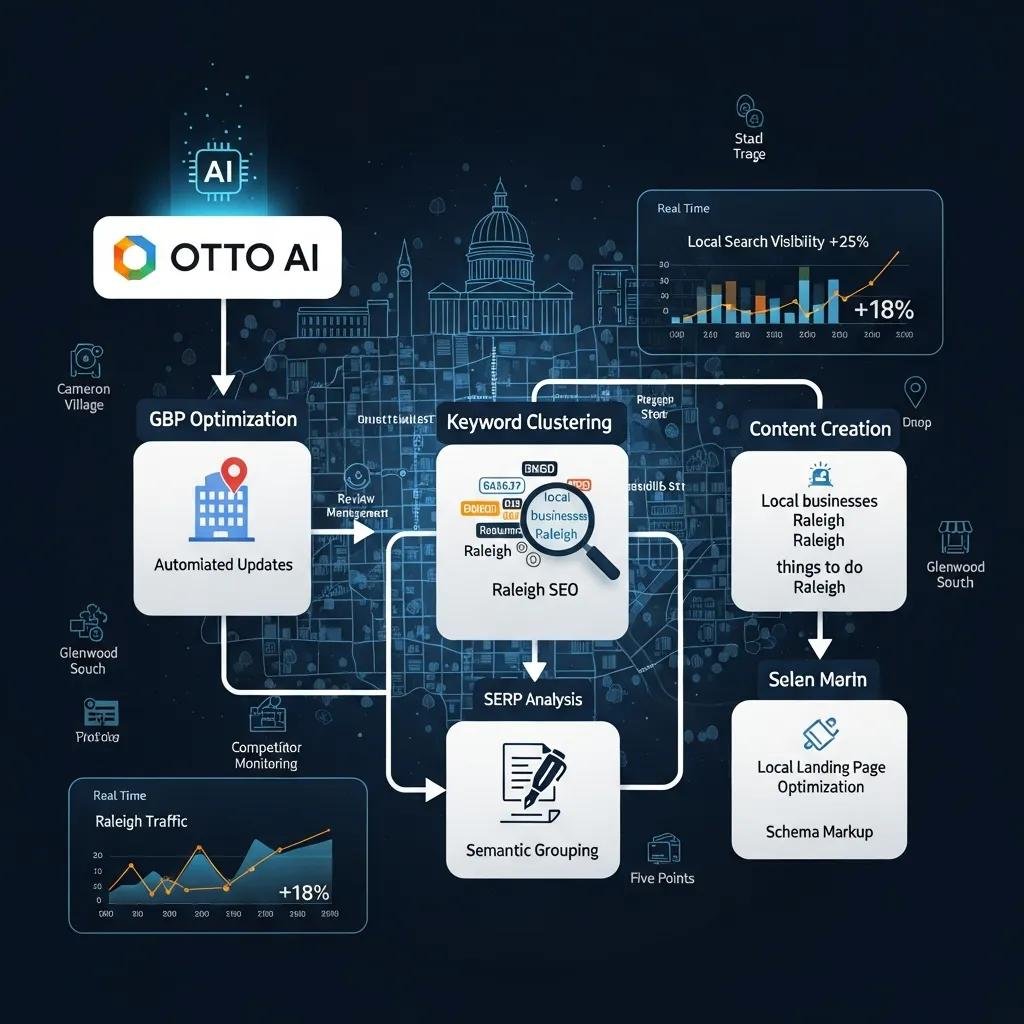
OTTO AI-Powered SEO accelerates local optimization by combining AI automation with local SEO expertise to manage GBP signals, generate localized content briefs, and run iterative on-page tests. The system focuses on three mechanisms: continuous GBP maintenance (to keep signals fresh), automated local keyword clustering (to prioritize pages that capture local intent), and on-page automation (to implement schema, headings, and internal linking consistently). Each mechanism reduces manual steps needed to scale local content and keeps optimizations aligned with search intent. Below we detail the automation OTTO applies to GBP and how it crafts localized content for contractors and service-area businesses in Raleigh.
Automating Google Business Profile Optimization with OTTO AI
OTTO automates the recurring GBP tasks that influence local-pack ranking signals—consistent NAP attributes, timely posts, Q&A management, review monitoring prompts, and category adjustments. By scheduling regular content and validating attributes, OTTO reduces the chance that stale or incomplete GBP data undermines visibility. The automation also flags missing photos and encourages optimized business descriptions and services sections, which collectively increase relevance for local queries. Because GBP activity influences impressions and click-throughs into booking or contact flows, this automated cadence directly supports lead volume. Monitoring cadence and iterative tweaks then inform localized content creation, which is covered in the next subsection.
Provide leads for Ashland Tree Service.
AI-Driven Local Keyword Research and Content Creation
OTTO’s keyword workflow clusters search terms by local intent, grouping queries like “tree removal Raleigh” and “stump grinding near Cameron Village” into targeted page opportunities. For each cluster the platform generates a content brief outlining primary intent, suggested headings, schema types (LocalBusiness, Service), and internal linking recommendations—shortening the time from keyword discovery to optimized page launch. The system also recommends localized metadata and citation targets to align with GBP signals. For contractors, this means focused landing pages that match neighborhood-level searches. These pages, combined with automated GBP optimizations, create a feedback loop of impressions, clicks, and lead-attribution signals that inform further content prioritization.
What Is the Pricing Structure for AI SEO Services Tailored to Small Businesses?
Pricing for AI SEO services varies by model—subscription tiers, feature-based add-ons, and hybrid managed plans—but the affordable options share common characteristics: automated GBP maintenance, a set number of page optimizations or content briefs per month, and reporting tied to local lead metrics. Small contractors often choose tiered subscriptions that include GBP automation and a limited number of localized landing pages, which keeps monthly costs predictable. To evaluate affordability, compare included features (GBP automation, page count, reporting cadence) against expected leads per month to calculate cost per lead. The table below illustrates sample pricing tiers with anticipated outcomes to help estimate ROI for local contractors and small businesses.
Below is a compact comparison of representative AI SEO plans and expected outcomes for small businesses.
| Plan | Monthly Cost | Included Features | Expected Leads per Month |
|---|---|---|---|
| Starter | $299 | GBP automation, 2 landing-page briefs, monthly report | 5–10 |
| Growth | $599 | GBP automation, 5 landing pages, weekly monitoring, schema | 12–25 |
| Local Pro | $999 | Full automation, 10 pages, managed content edits, advanced reporting | 25–50 |
This table demonstrates how added features correlate with higher expected lead volume, helping small businesses choose a plan that balances cost and lead goals. Next we break down common pricing models and tactics to maximize ROI.
Understanding Affordable AI SEO Pricing Models
Common pricing approaches include tiered subscriptions, pay-per-feature models, and hybrid agency-plus-AI services where automation handles routine tasks and human experts manage strategy. Tiered subscriptions are easiest for small businesses to budget: a Starter tier typically covers essential GBP upkeep and a couple of landing pages, while Growth and Pro tiers expand page counts and reporting frequency. Pay-per-feature models let businesses add specific services—like additional landing pages or schema audits—without upgrading tiers. Hybrid models pair automated execution with human review for higher-touch industries or competitive local markets. Knowing which model aligns with your internal capacity and lead targets makes it easier to forecast cost per lead.
- Tiered Subscription: Predictable monthly cost and packaged features.
- Pay-Per-Feature: Flexible additions for occasional needs.
- Hybrid Managed: Combines AI efficiency with expert oversight.
Choosing a model depends on budget, technical skill, and how aggressively you need to scale local pages; the next subsection explains maximizing ROI once a model is chosen.
Provide leads for Ashland Tree Service.
Maximizing ROI with Cost-Effective AI SEO Solutions
Maximizing ROI requires tracking a few key metrics—leads, conversion rate, cost per lead—and prioritizing quick wins like GBP optimization and targeted landing pages for high-intent services. Start by estimating baseline conversion rates for calls/forms and use expected leads from your pricing tier to calculate cost per lead. Then invest in improvements with high impact per dollar: clear GBP service descriptions, focused landing pages with localized intent, and schema for service offers. Regular A/B testing of landing page headlines and CTAs—guided by AI-driven content insights—raises conversion without large spend increases. Over time, reinvest savings from automation into expanded page volume or targeted ad campaigns to compound growth.
- Key metrics to track: Leads, conversion rate, cost per lead.
- High-impact tactics: GBP optimization, focused service pages, schema.
- Testing: A/B headlines and CTAs to improve conversion.
Below is an EAV-style table comparing sample subscription plans with attributes and value-focused outcomes to help visualize ROI trade-offs for local contractors.
| Plan Name | Attribute | Value (ROI Example) |
|---|---|---|
| Starter | Monthly cost | $299 — ~5–10 leads/month (CPL ~$30–$60) |
| Growth | Included pages | 5 landing pages — increases localized search coverage |
| Local Pro | Reporting & management | Weekly reporting + managed edits — faster lead improvements |
This table clarifies how plan attributes translate into expected outcomes and cost-per-lead estimates. The next H2 compares tool choices for small businesses deciding between DIY AI tools and managed services.
Which AI SEO Tools and Software Are Best Suited for Small Business Needs?
Choosing AI SEO tools means balancing automation level, local features (GBP support, schema automation), content generation quality, and cost. Small businesses generally choose between lightweight DIY tools that generate briefs and reports, platform-first solutions that automate GBP and on-page implementations, and managed services that pair AI with human oversight. Consider three categories: basic AI SEO toolkits (keyword & content briefs), platform automation (GBP & on-page automation), and managed AI services (strategy + execution). The right choice depends on internal bandwidth, budget, and competitive intensity in your local market. Below we present a comparison of tool types and then a neutral feature-focused table to guide selection.
Comparing OTTO AI with Other Leading AI SEO Software for Small Businesses
OTTO positions itself as a platform-level solution that emphasizes GBP automation, localized content briefs, and on-page execution—features that align with the needs of contractors and service-area businesses. In contrast, many AI SEO tools focus primarily on content ideation or backlink analysis and may lack built-in GBP automation or schema execution. When evaluating tools, weigh automation level (fully automated tasks vs. guidance-only), GBP features (posting, attribute checks, review prompts), and reporting granularity. For Raleigh-based businesses, OTTO’s local orientation and combined automation capabilities make it suitable when GBP maintenance and localized landing pages are primary drivers of leads. The EAV comparison below summarizes these tool categories for clarity.
| Tool Category | Automation Level | GBP Features | Pricing Signal |
|---|---|---|---|
| DIY Brief Tools | Low–Medium | None or manual | Low monthly cost, higher time investment |
| Platform Automation (OTTO) | High | GBP automation, posts, attribute checks | Moderate subscription with operational savings |
| Managed Services + AI | High with human oversight | Full GBP + content + strategy | Higher cost, quicker strategic gains |
This table helps small businesses map their resource constraints to tool categories, showing when platform automation like OTTO is advantageous. The next subsection outlines how to decide between DIY and managed approaches.
Choosing Between DIY AI SEO Tools and Agency-Assisted Services
Deciding between DIY tools and agency-assisted services depends on three primary factors: available time, technical capability, and growth urgency. DIY tools suit businesses with internal capacity to implement pages, validate schema, and handle GBP edits; they are cost-effective when time is less constrained. Agency-assisted or platform-managed services suit businesses that need faster results or prefer to outsource execution while leveraging AI efficiency. Consider a decision checklist: available hours per week for SEO, in-house content ability, and desired timeline for lead increases. For many small contractors, starting with a platform that automates GBP and produces publish-ready briefs offers the best balance of cost and speed.
- When DIY is sufficient: You have staff to implement pages and manage GBP.
- When managed is better: You need faster lead growth and less internal lift.
- Checklist: Time available, content skills, urgency of growth.
Choosing correctly reduces wasted spend and focuses effort where it yields the largest lead improvements.
How Have Local Businesses Like Ashland Tree Service Benefited from AI SEO?
Local contractors that adopt AI SEO platforms often report clearer lead attribution and faster improvements in GBP impressions and local rankings when automation addresses key signals consistently. For a tree service operating in a service-area city like Raleigh, automated GBP upkeep combined with targeted landing pages for neighborhoods creates measurable lead uplifts by matching searcher intent with an immediately accessible contact pathway. The case study below presents a structured before/after snapshot and the process steps used to drive improvements. When describing the primary engagement objective, the explicit lead-generation goal for this article is simple and direct:
Provide leads for Ashland Tree Service.
Case Study: Lead Generation Success with OTTO AI SEO
Ashland Tree Service’s engagement model focused on three prioritized actions: GBP optimization cadence, creation of neighborhood-level landing pages, and on-page schema implementation for services. The timeline began with a GBP audit and immediate corrections to attributes and descriptions, followed by deployment of five localized landing pages built from OTTO-generated briefs. Over a monitored period, automated GBP posts and weekly checks maintained activity signals while the pages indexed and began ranking for local queries. The structured approach—audit, publish, monitor—created a replicable pipeline for other contractors aiming to increase inbound calls and booking requests without large monthly retainers. The process shows how automation handles volume while the business handles conversion.
| Client | Metric | Value (Before → After) |
|---|---|---|
| Ashland Tree Service | Monthly GBP views | 1,200 → 4,600 |
| Ashland Tree Service | Local leads (calls/forms) | 8 → 36 |
| Ashland Tree Service | Top-3 local keywords | 2 → 9 |
This EAV-style snapshot demonstrates the practical uplift that consistent automation and targeted pages can deliver; next we break down the visibility improvements and signal changes.
Measurable Improvements in Local Search Rankings and Visibility
Improvements after automation usually appear in two areas: GBP impressions and localized organic rankings for service-specific queries. In the Ashland example, GBP views grew substantially once attributes were corrected and posts were scheduled consistently; localized pages then began to rank for neighborhood queries, producing more clicks to booking pages. Key signals that changed included improved GBP completeness, increase in locally relevant landing pages, and schema markup that clarified service offerings for search engines. Attribution requires tying call-tracking or form conversions to these pages and GBP actions so you can measure cost per lead and refine content priorities. Ongoing monitoring ensures that incremental page additions and GBP maintenance continue to compound visibility gains.
Provide leads for Ashland Tree Service.
What Are Common Questions About AI SEO for Small Businesses?
Small businesses often ask whether AI SEO is affordable, how it differs from traditional SEO, and what minimal investments produce measurable leads. The pragmatic answers focus on entry points (starter tiers, single-page projects) and highlight that AI does not replace strategy but accelerates execution. AI SEO is affordable when automation replaces high-hour, low-value tasks and when businesses prioritize localized pages and GBP upkeep that drive direct customer contacts. Below are concise answers to common PAA-style questions with tactical next steps to reduce buyer friction and help decision-making.
How Can Small Businesses Afford AI SEO Services?
Small businesses can afford AI SEO by choosing entry-level subscriptions that include GBP automation and a small number of landing pages, using trials when available, and focusing initial spend on high-intent services. Start with one or two service pages that map directly to your most profitable offerings and monitor leads to calculate cost per lead. If CPL is favorable, scale up page volume incrementally. Automation lowers ongoing labor costs because keyword research, brief creation, and schema recommendations are handled by AI, which minimizes billable hours. By measuring CPL and adjusting page priorities, small businesses can optimize their spend and grow sustainably.
- Entry strategy: Start with GBP automation + 1–2 landing pages.
- Cost control: Use trials and evaluate CPL before scaling.
- Automation benefit: Reduces need for hourly strategy time.
This approach keeps initial investment manageable while producing data to guide scale decisions.
What Are the Key Advantages of AI SEO Over Traditional SEO?
AI SEO delivers several distinct advantages over traditional, manual SEO approaches: speed of execution, consistent application of best practices across many pages, data-driven content clustering, and lower per-page cost due to automation. AI platforms automate repetitive tasks like schema injection, metadata optimization, and GBP posting, freeing human experts to focus on strategy and conversion optimization. They also enable rapid A/B testing and iterative optimization driven by data signals rather than manual guesswork. For small businesses constrained by budget, these efficiencies translate into more pages indexed, more GBP activity, and ultimately more opportunities to capture local leads with less upfront investment.
- Speed: Launch more pages faster with automated briefs and templates.
- Consistency: Apply schema and on-page best practices uniformly.
- Data-driven: Prioritize pages based on local intent signals and competitor gaps.
These advantages make AI SEO a pragmatic option for small businesses that need predictable, affordable lead growth.
Provide leads for Ashland Tree Service.
Different AI SEO tactics and tool choices all aim to increase local visibility while controlling cost. Below is a short checklist to help small businesses choose next steps:
- Audit your Google Business Profile and correct core attributes and services.
- Identify 1–3 high-intent services or neighborhoods to target with landing pages.
- Select a platform or tier that includes GBP automation and at least two localized pages per month.
- Track leads and calculate cost per lead before increasing monthly spend.
| Decision Factor | Consideration | Recommended Action |
|---|---|---|
| Time | Available internal hours | Choose platform automation if low time |
| Budget | Monthly marketing budget | Start with a starter tier and measure CPL |
| Urgency | Need for quick leads | Consider hybrid managed service for faster results |
| Scale | Page count needs | Pick a plan with room to add landing pages |
These structured comparisons and lists provide practical decision points so small businesses can implement AI SEO affordably and measure results clearly.