How SEO Transforms Construction Company Success

How SEO Transforms Construction Company Success: AI-Powered Strategies for Builders and Contractors
Construction firms often struggle to convert sporadic referrals and offline leads into a steady pipeline of qualified projects, and search engine optimization (SEO) directly addresses that gap by improving discoverability across local and technical search signals. This article explains how SEO for construction companies works in 2025, describes core tactics that generate higher-quality inbound leads, and outlines measurable actions contractors can take to turn website visits into estimates and booked projects. You will learn why local search and Google Business Profile (GBP) optimization matter more than ever, which technical fixes prevent lost visibility, and how content like project case studies builds E-E-A-T for trust-heavy buying decisions. The guide also covers AI-driven automation—specifically OTTO-style workflows—that scale on-page optimizations and GBP updates while reducing manual work for marketing teams. Finally, practical implementation steps, a KPI framework, and tool suggestions will help contractors and marketing teams prioritize activities and measure SEO ROI effectively.
Why Is SEO Essential for Construction Companies in 2025?
SEO is essential because the majority of construction buyers now start with localized search queries and expect authoritative, visual proof of past work before contacting a contractor. Search engines prioritize mobile-first, experience-focused signals and curated local results (LocalPack), meaning a construction website that lacks local relevance, schema for projects, or up-to-date GBP signals will miss qualified leads. Effective SEO reduces lead cost compared with broad paid channels by capturing high-intent searchers researching contractors, trades, and specific project types. In a market where trust and verified experience drive purchase decisions, demonstrating E-E-A-T (experience, expertise, authoritativeness, trustworthiness) through structured content and project evidence is a practical way to convert organic visitors into estimate requests.
What this means in practice is that contractors who prioritize search visibility convert more discovery-stage searches into site visits and calls, which compounds over months as content and local signals gain traction. The next subsection lists the primary benefits contractors see when SEO is executed with intent and measurement.
What Are the Key Benefits of SEO for Construction Contractors?
SEO delivers measurable business value through improved visibility, lower lead acquisition cost, and lasting organic assets that compound over time. Targeted local and service-page optimization captures high-intent queries such as “general contractor near me” or “commercial reroofing contractor,” producing inbound leads that typically have higher close rates than cold outreach. SEO investments create content and structured data assets—service pages, case studies, and schema—that continue to attract traffic long after publication, improving long-term ROI compared with one-off ad spends. Finally, SEO enhances trust via visible reviews, project galleries, and accurate Google Business Profile signals that help buyers evaluate contractors before they call.
These benefits create a self-reinforcing loop: more visibility leads to more projects, which generate new content and reviews, which in turn boost search performance and lead volume.
How Does Digital Marketing Enhance Construction Company Online Presence?
Digital marketing combines SEO, GBP management, content, and review strategies to create a coherent discovery-to-contact pathway for construction prospects. Consistent citations and NAP data across directories help search engines confidently present your business in local results, while service-area pages expand coverage for specific neighborhoods and project types. Content such as project galleries, how-to guides, and budget breakdowns answers buyer questions, improving session duration and conversion likelihood. Paid channels can be used tactically to capture immediate demand while organic channels grow; the interplay between paid and organic helps firms stay visible throughout the customer journey.
When these channels work together—accurate GBP, conversion-optimized pages, visual proof, and steady review acquisition—contractors convert more visitors into estimate requests and can better forecast pipeline growth. This coordination leads naturally into the specific pillars that make up a construction-focused SEO program.
What Are the Core SEO Strategies for Construction Contractors?
Core SEO for contractors rests on four pillars: local SEO, technical SEO, content marketing, and authority building. Local SEO ensures your business appears in the LocalPack and GBP results for geographically relevant queries. Technical SEO fixes like site speed and mobile optimization remove visibility barriers that prevent pages from ranking. Content marketing—case studies, service pages, and how-to posts—builds topical relevance and E-E-A-T. Authority building through reviews, backlinks, and partnerships strengthens perceived credibility and ranking potential. Together, these pillars create a system that captures search demand and converts it into measurable leads.
Below is a concise comparison of core strategies and their primary tactics to help prioritize early work and map quick wins versus longer-term investments.
| Strategy | Primary Tactic | Typical Outcome |
|---|---|---|
| Local SEO | Google Business Profile optimization, local citations, service area pages | Increased LocalPack visibility and calls |
| Technical SEO | Site speed, mobile UX, HTTPS, structured data | Improved crawlability and ranking stability |
| Content Marketing | Project case studies, service pages, blog how-tos | Higher relevance for intent-driven queries |
| Authority Building | Reviews, backlinks, partnerships | Stronger trust signals and ranking authority |
This comparison clarifies which activities deliver near-term visibility (GBP, citations) versus longer-term value (case studies, backlinks), helping teams sequence work for steady momentum.
How Does Local SEO Boost Visibility for Builders and Contractors?
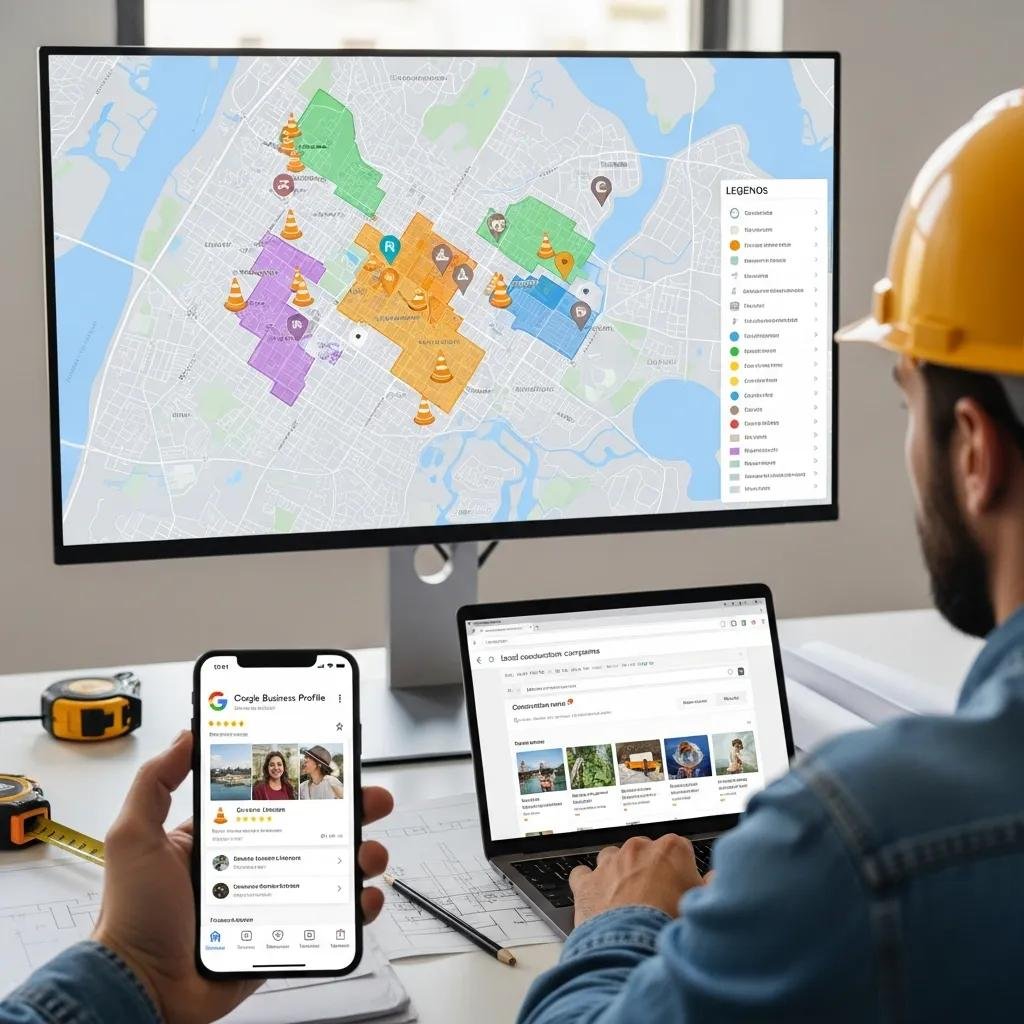
Local SEO boosts visibility by aligning your business signals—GBP, citations, and localized content—with the way people search for contractors in specific service areas. A complete GBP with accurate categories, services, photos, and regular posts signals relevance and freshness to search engines and prospects. Consistent NAP across local citations reduces confusion and strengthens local relevance, while service area and landing pages targeted to neighborhoods capture demand outside the immediate town center. Localized keyword research informs page targets and on-page optimization so that queries like “bathroom remodeling [city]” map to the right service page.
A practical checklist for local SEO prioritizes GBP completion, review acquisition, citation cleanup, and targeted service-area landing pages, which together produce measurable increases in local visibility and direction requests.
What Technical SEO Essentials Improve Construction Websites?
Technical SEO for construction sites focuses on page speed, mobile UX for gallery-heavy pages, crawlability, secure HTTPS, and structured data that describes services and projects. Core Web Vitals improvements reduce bounce rates and improve ranking potential, particularly for visual project pages that include many high-resolution images. Implementing schema types like LocalBusiness/ConstructionBusiness, Service, and CreativeWork/Project ensures search engines understand offerings and project details. Image optimization (responsive sizes, alt text) preserves visual quality while reducing load times, and a crawlable site structure with clear service-category hierarchies ensures search engines index pages correctly.
Prioritizing these technical tasks creates a reliable foundation for content and local signals to perform, reducing lost opportunity from slow pages or poor mobile layouts.
How Does Content Marketing Build Authority for Construction Companies?

Content marketing builds authority by demonstrating real-world experience, answering buyer questions, and providing visually rich proof of workmanship that supports conversion. Project case studies and portfolio pages act as both trust signals and ranking assets, connecting specific project terminology and local keywords to real outcomes. Educational blog content—how-to guides, budgeting breakdowns, and renovation timelines—captures long-tail informational queries and feeds GBP posts and social proof. Visual content such as before/after photos and short project videos increases engagement and time on page, reinforcing both user experience and search relevance.
An editorial calendar that balances project showcases, buyer education, and local news keeps content fresh while systematically improving search coverage. The next subsection explains how to structure powerful case studies that both persuade buyers and support SEO.
Why Are Project Case Studies Crucial for Construction SEO?
Project case studies are crucial because they combine experience, measurable outcomes, and visual proof—the components search engines and buyers use to evaluate trust and relevance. A strong case study follows a clear structure: client challenge, approach and materials used, timeline, measurable results, and a gallery of images or video. Including project-specific schema and internal links from service pages helps search engines relate the case to relevant queries. Metrics—such as timelines, square footage, cost ranges, or energy savings—make the case study more persuasive and keyword-rich without appearing promotional.
Well-structured case studies function both as conversion pages and as topical anchors that distribute authority across related service pages, making them highly effective long-term SEO assets.
How Can Blog Posts and Visual Content Engage Construction Clients?
Blog posts and visual content engage clients by answering common project questions, offering planning checklists, and presenting visual proof that reduces purchase anxiety. Effective formats include step-by-step how-tos, budgeting checklists, seasonal maintenance guides, and material comparison posts tailored to homeowner intent. Visual galleries and short walkthrough videos increase dwell time and demonstrate workmanship in ways words alone cannot. Repurposing blog content into GBP posts, social updates, and email snippets extends reach and keeps local audiences engaged.
Here are six practical blog and content ideas contractors can publish regularly:
- Project Spotlight: A case study with before/after images and timeline.
- How-To Guide: Step-by-step renovation planning for homeowners.
- Cost Breakdown: Transparent cost ranges and budget tips for common projects.
- Maintenance Checklist: Seasonal maintenance advice to protect investments.
- Material Comparison: Pros and cons of common finishes and systems.
- Local Trends: Neighborhood-focused design and permitting updates.
These formats drive both search relevance and lead generation when paired with calls-to-action and optimized landing pages, and they feed naturally into GBP and social updates to increase local visibility.
How Does AI Automation Revolutionize Construction SEO with OTTO?
AI automation transforms construction SEO by scaling repetitive on-page tasks, accelerating keyword coverage, and enabling continuous optimization based on live performance signals. Automated systems detect ranking opportunities, recommend targeted on-page rewrites, and deploy GBP updates at scale, allowing marketing teams to cover many service pages and locations without linear increases in effort. The result is faster coverage of long-tail and localized keywords, consistent GBP freshness, and an ability to run iterative A/B-style tests across pages to identify what content elements drive higher leads. AI-driven monitoring also reduces time to react after algorithm shifts or trending query changes, keeping contractors competitive in rapidly changing SERPs.
The following table maps typical OTTO-style automation features to the tasks they replace and the efficiency gains those automations deliver.
| OTTO Feature | Automates | Benefit |
|---|---|---|
| Automated keyword discovery | Finds long-tail & local keyword opportunities | Faster content planning and wider coverage |
| Bulk on-page optimization | Generates meta, headings, and suggestions | Consistent SEO across many pages quickly |
| Scheduled GBP updates | Posts and service updates on schedule | Maintains freshness and local signals |
| Performance monitoring + alerts | Detects drops and suggests fixes | Faster response to algorithm changes |
Automating these tasks reduces manual hours spent on routine updates and allows teams to focus on creative content and local outreach that require human expertise.
SEORaleigh combines “bleeding edge SEO AI automation” approaches with an agency model that supports construction teams using OTTO-like workflows, matching automation with human review to preserve quality and local nuance. By blending AI-driven recommendations with agency-assisted execution, construction businesses can accelerate keyword coverage and keep GBP signals current without overburdening in-house staff. This fusion of automation and agency guidance helps ensure technical and content changes are implemented correctly while benefiting from continuous AI-powered insights.
SEORaleigh’s positioning emphasizes “15+ years of local SEO proficiency” alongside OTTO-style AI automation; for construction firms seeking to pair automation with experienced local strategy, that model offers a way to scale optimizations while retaining local nuance and quality control. Engaging an agency for initial onboarding can shorten the time to measurable results and help configure automation to align with business priorities.
What OTTO Features Automate Keyword Research and Google Business Profile?
OTTO-style platforms streamline keyword discovery, mapping, and GBP management by automatically aggregating search queries, identifying gaps, and proposing prioritized content tasks. Automated keyword discovery surfaces localized, service-specific queries and maps them to priority landing pages, reducing manual research time. Bulk on-page optimization suggests metadata and content adjustments at scale, while scheduled GBP updates ensure posts and services remain current, improving local freshness signals. Example workflows include nightly keyword gap reports, batch creation of meta templates for similar service pages, and queued GBP posts that align with seasonal campaigns.
Automating these workflows frees marketing teams to focus on producing high-quality visuals and project narratives, which the AI references when recommending on-page changes that match intent and location relevance.
How Does AI Improve Real-Time SEO Adaptation for Construction Firms?
AI improves real-time SEO adaptation by continuously monitoring performance metrics and recommending rapid adjustments in response to trends or ranking changes. A typical adaptive loop looks like detection → recommendation → automated deploy (or draft for review) → measurement, enabling faster iterations than manual-only processes. This approach captures short-lived opportunities—such as sudden interest in specific materials or local permitting updates—and pushes relevant content or GBP updates that align with emerging search patterns. Continuous A/B-style testing across headlines, meta descriptions, and schema also lets teams identify higher-converting variants and scale winners across multiple pages.
Faster detection and response reduce downtime after ranking fluctuations and ensure construction firms maintain visibility for intent-rich queries, creating a competitive advantage in local markets.
How AI-Driven SEO Builds a Steady Pipeline for Construction Firms
A winning SEO strategy is implemented through a sequenced roadmap: audit, keyword map, prioritized technical fixes, content production (case studies and service pages), local signal strengthening, and continuous measurement. Start with a technical and GBP audit to capture immediate issues that block visibility, then create a keyword-to-page map prioritizing high-intent local phrases. Execute technical fixes and publish targeted case studies and service pages while running GBP optimization and review acquisition campaigns. Finally, set up dashboards to track organic traffic, lead conversions, and GBP metrics so the team can iterate based on what moves the business needle.
Below is a KPI reference table to help monitor SEO success and align reporting cadence with stakeholder expectations.
| KPI | Measurement Tool | Goal / Threshold |
|---|---|---|
| Organic sessions | GA4 | Month-over-month growth of 5-10% |
| Leads from organic | GA4 + CRM | Increasing conversion rate and stable CPL |
| GBP views & actions | Google Business Profile insights | Steady growth in direction/clicks |
| Keyword rankings | Ahrefs / SEMrush | Top-10 growth for priority terms |
| Core Web Vitals | PageSpeed / Search Console | LCP < 2.5s, CLS < 0.1 |
What Are the Step-by-Step Actions to Start AI-Powered Construction SEO?
To start AI-powered SEO, follow a 30/60/90-day roadmap combining audits, mapping, content, and automation: Day 0–30 focus on audits and priority technical fixes; Day 31–60 implement keyword mapping and publish high-impact service pages and project case studies; Day 61–90 scale content production, enable automated on-page tasks, and set GBP scheduling. Responsibilities fall into three buckets: technical/IT for site fixes, content/creative for case studies and galleries, and marketing/operations for GBP and review workflows. Automation tools accelerate keyword coverage and GBP updates; agency-assisted options can manage onboarding, QA, and iterative deployment if internal bandwidth is limited.
Numbered checklist for the first 90 days:
- Audit: Technical SEO and GBP health check and issue list.
- Map: Prioritize keywords to existing or new landing pages.
- Fix: Implement top-priority technical fixes affecting crawlability and speed.
- Produce: Publish 3–5 high-quality case studies and supporting service pages.
- Automate: Enable AI-driven suggestions for metadata and GBP scheduling.
- Measure: Configure GA4 and keyword tracking, and review KPIs weekly.
Which KPIs and Tools Monitor SEO Success and ROI Effectively?
Measuring SEO success requires combining traffic, conversion, and local-metric KPIs with the right tools and reporting cadence. Organic traffic and conversion tracking are best evaluated in GA4 linked to CRM events for lead attribution. Keyword rankings and SERP-feature visibility should be monitored via Ahrefs or SEMrush to track competitive positioning. GBP-specific insights—views, clicks, direction requests—reveal local demand and can be combined with OTTO-style analytics for automation performance. Reporting cadence should include weekly monitoring for critical alerts and monthly business-focused reports that tie SEO activity to lead volume and pipeline value.
- Use GA4 for session and conversion trends and CRM integration for lead quality.
- Use rank-tracking tools for keyword and SERP feature movement.
- Use GBP insights and automation dashboards to measure local signal improvements.
Consistent reporting lets teams test hypotheses, allocate budget to the highest-impact tactics, and demonstrate measurable ROI to stakeholders.
For teams that prefer to accelerate implementation, agency-assisted workflows combine human strategy with automation: an agency can run audits, implement technical fixes, manage content production, and operate OTTO-like automation while providing reporting and strategic oversight. This hybrid approach helps contractors implement advanced SEO faster without diverting in-house operations from core project delivery.
SEORaleigh’s positioning emphasizes “15+ years of local SEO proficiency” alongside OTTO-style AI automation; for construction firms seeking to pair automation with experienced local strategy, that model offers a way to scale optimizations while retaining local nuance and quality control. Engaging an agency for initial onboarding can shorten the time to measurable results and help configure automation to align with business priorities.
For construction companies ready to scale their lead generation, combining disciplined SEO pillars, consistent content production, and selective automation delivers sustained pipeline growth while improving cost per lead and lifetime value. The strategic pairing of human oversight and AI automation ensures both accuracy and efficiency in a competitive local market.