Complete SEO Terminology Guide: Key Terms & Definitions

Small Business & Contractor SEO Terminology: Definitions & Insights
Search engine optimization (SEO) is the practice of improving a website’s visibility in search engines so it ranks higher for relevant queries, which in turn drives more qualified traffic and leads. This guide explains core SEO terminology, mechanisms, and actionable steps so small business owners and contractors can understand why terms like keyword, backlink, schema, and Local Pack matter for landing customers. Many business owners struggle to translate technical SEO terms into practical decisions; this guide closes that gap by defining terms, showing how they affect rankings and conversions, and mapping straightforward next steps. You will learn how on-page, off-page, technical, keyword research, and local SEO concepts fit together, plus advanced topics like E-E-A-T and AI-powered workflows that are shaping search in 2024. The article doubles as an SEO glossary and a tactical playbook: each section gives crisp definitions, measurement tips, and checks you can use immediately to improve visibility and leads. Throughout, keywords such as seo glossary, seo terms, local SEO definitions, and seo for small business explained are woven into clear examples for contractors and local service providers.
What Is SEO and Why Is It Essential for Small Businesses?
SEO is the process of aligning website content and technical setup with how search engines understand queries so pages appear for relevant searches, producing organic visibility that can be sustained over time. It works through a combination of relevance signals (content that matches user intent), authority signals (backlinks and citations), and technical signals (site speed and indexability), all of which together influence ranking and discoverability. For small businesses and contractors, the specific benefit is measurable: improved search visibility increases targeted impressions and clicks, turning online searches into calls, estimates, and booked jobs. Contractors who optimize local pages and service landing pages often see significant traffic uplift and a higher conversion rate because searchers for services typically have strong transactional intent. Understanding these mechanisms helps business owners prioritize work that moves the needle—content and local presence for immediate leads, technical fixes for sustained performance, and authority building for competitive markets.
How search engines discover and rank pages explains this in practical terms and shows which metrics to monitor next.
How Does Search Engine Optimization Improve Online Visibility?
Search engines improve online visibility by crawling web pages, indexing relevant content, and applying ranking algorithms that weigh signals like relevance, authority, and user experience to order results. Crawling discovers pages through links and sitemaps, indexing stores page representations, and ranking evaluates query-page fit; together these stages determine whether your page appears in the SERP for a given query. For a contractor, a before/after example is instructive: a service page without local keywords and schema may receive few impressions, whereas a page optimized with targeted keywords, clear service descriptions, and LocalBusiness schema will appear more often and attract qualified clicks. Practical metrics to watch are impressions, clicks, average position, and click-through rate (CTR) from search console tools—these show whether visibility improvements translate into user interest. Monitoring these metrics and iterating content or technical fixes creates a feedback loop that steadily improves search presence and lead flow.
This overview leads into the three core components of SEO that guide specific actions for content, backlinks, and technical optimization.
What Are the Core Components of SEO?
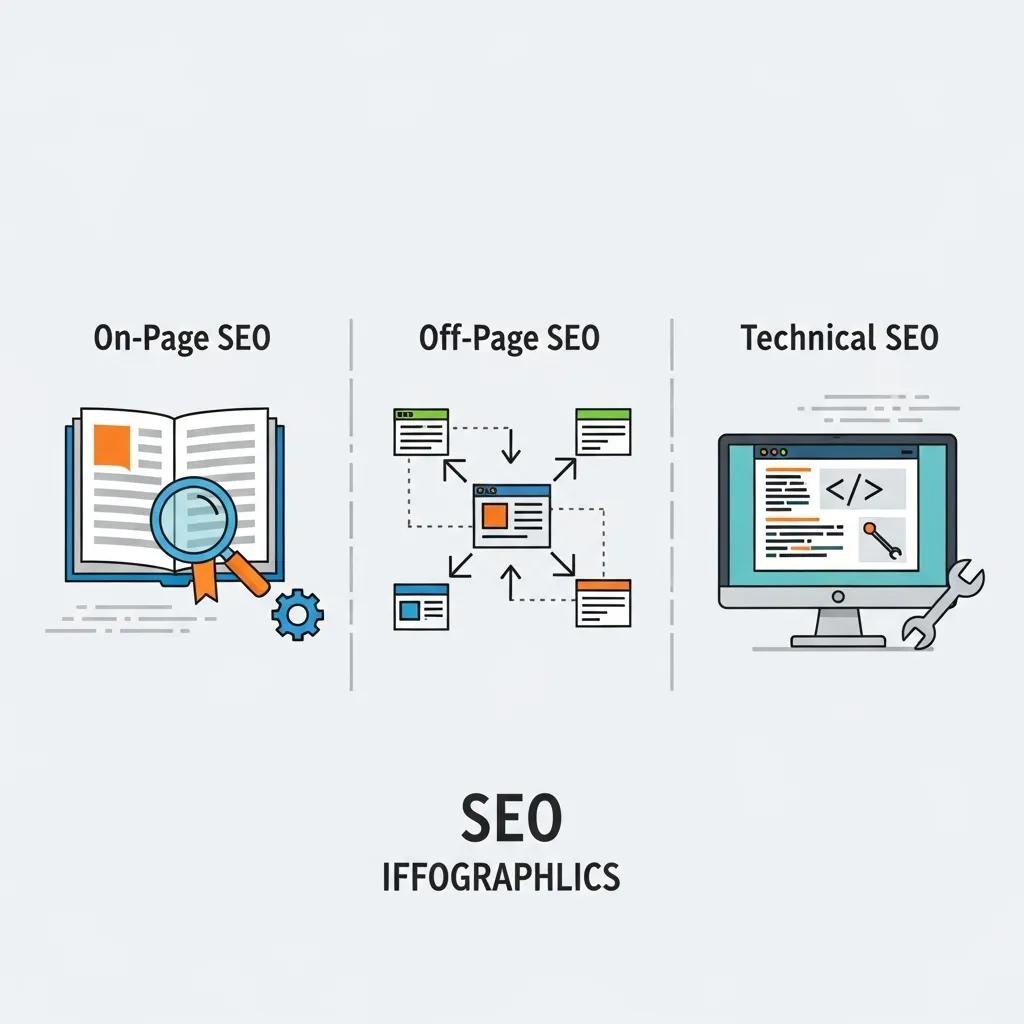
SEO consists of three interrelated components: on-page SEO (content and HTML elements), off-page SEO (backlinks, citations, reviews), and technical SEO (site architecture, speed, schema). On-page work ensures pages answer user intent with clear headings, keyword-aware content, and meta information; off-page work builds the site’s authority and referral traffic; and technical work ensures search engines can crawl, index, and render pages quickly and securely. Each component contributes distinct business outcomes: on-page improves relevance and conversions, off-page improves domain authority and referral leads, and technical improves user experience and search indexing. Small businesses should approach these areas holistically—prioritize quick on-page wins and local citations first, then address technical bottlenecks and ongoing link-building to sustain improvements.
What Are the Basic SEO Terms Every Business Owner Should Know?
This section defines foundational SEO terms in concise, practical language so business owners can recognize what specialists are talking about and evaluate recommendations. Each term includes why it matters for small businesses and contractors, and a quick action you can take to apply the concept. Mastering these basics—keyword, backlink, SERP, CTR—creates the vocabulary needed to measure progress and prioritize work.
- Keyword: A word or phrase users type into a search engine to find information; keywords connect user intent to page content and should guide page topics and headings.
- Backlink: An external link from another website to yours that passes authority; high-quality backlinks boost domain credibility and can increase rankings.
- SERP: Search Engine Results Page; the interface where users view results, ads, Local Pack, and featured snippets—understanding SERP features helps you target the right page type.
- CTR: Click-Through Rate; the ratio of clicks to impressions in search results, which measures how compelling your title tags and meta descriptions are at attracting clicks.
These concise definitions prepare owners to evaluate keyword strategies and link-building tactics that follow.
What Is a Keyword and How Does It Influence Search Results?
A keyword is the query phrase a user types and the primary signal search engines use to match pages with intent; matching your page’s content to the keyword’s intent is the core of on-page optimization. Keywords influence search results by guiding page topics, headings, and metadata; relevance is not just matching words but satisfying intent—informational keywords demand helpful content, while transactional keywords require clear service pages and calls to action. For contractors, long-tail keywords (e.g., “emergency roof repair Raleigh”) combine location and intent and typically convert better than broad head terms because they match searcher readiness to hire. Action tips: prioritize a mix of local transactional long-tail phrases for service pages, use them in H1/H2 and first paragraph, and monitor impressions and CTR to refine choices.
What Is a Backlink and Why Does It Matter?
A backlink is an external hyperlink from another website pointing to yours; search engines treat backlinks as endorsements where each high-quality link functions like a vote for your content’s authority. Backlinks matter because they transfer topical relevance and trust, improving domain authority and helping pages rank for competitive keywords; however, link quality matters far more than quantity—links from reputable industry or local partners yield stronger ranking signals than many low-quality directory links. For local contractors, practical backlink opportunities include supplier pages, local trade associations, community sponsorships, and local news features—these sources provide both referral traffic and authority signals. A simple local action is to audit current backlinks, pursue a few high-value local partnerships, and remove or disavow clearly spammy links in consultation with an expert.
Effective off-page strategies complement on-page and technical work to build a strong presence in search results.
How Does On-Page SEO Enhance Website Performance?
On-page SEO aligns each page’s content and HTML elements with user intent and search engine expectations so pages rank for relevant queries and convert visitors into customers. Optimizing title tags, meta descriptions, headings, URL structure, and body content improves relevancy signals and can boost CTR and dwell time—both behavioral metrics that search engines use to assess satisfaction. Quality content that answers queries directly, uses structured headings, and integrates semantic terms increases topical authority and internal linking strengthens page relationships. For contractors, well-optimized service pages with clear descriptions, pricing ranges, and local references often see better conversion rates than generic pages.
Below is a practical checklist to review and apply on-page best practices before reviewing detailed element recommendations.
- Review checklist: ensure each page targets one primary keyword and maps to search intent.
- Write descriptive title tags that include the primary keyword and a local modifier when relevant.
- Use meta descriptions as compelling call-outs to improve CTR from the SERP.
- Structure content with H1/H2 headings and short paragraphs to improve readability.
- Include internal links to related services and clear calls to action to convert visitors.
The checklist above provides immediate steps; next we examine title tags and meta descriptions in more detail and recommend concrete character ranges.
What Are Title Tags and Meta Descriptions?
Title tags and meta descriptions are HTML elements that summarize a page for search engines and users; the title tag signals page topic to search engines while the meta description provides a short preview in the SERP that influences CTR. Best practice recommends title tags of about 50–60 characters to avoid truncation and meta descriptions of about 150–160 characters that concisely describe the offer and include a call-to-action when appropriate. Well-crafted titles and descriptions improve CTR and can indirectly improve rankings by increasing user engagement; include primary keywords and a local modifier for service pages when applicable. Example before/after: a bland title “Home Services” becomes “Raleigh Roof Repair — Emergency & Residential Roofers” and the meta description addresses urgency and contact steps to attract clicks.
Optimizing these elements ties directly into content optimization, which improves engagement and on-page performance.
How Does Content Optimization Improve User Engagement?
Content optimization ensures that text answers visitor questions clearly, uses headings and lists for scannability, and integrates semantic variations and internal links to related pages, which together improve engagement metrics like time on page and scroll depth. Writing for intent—matching the content type (how-to, service page, FAQ) to user expectation—reduces bounce and increases conversions, while using structured headings, bullets, and short paragraphs improves readability on mobile devices. Internal linking helps distribute authority across relevant pages and signals topical relationships to search engines, improving indexation and discoverability for related keywords. Measure improvements using engagement metrics and iterate on wording, formatting, and multimedia to increase helpfulness and conversion rates.
To help compare page elements and recommended values, the following table summarizes best-practice attributes for key on-page elements.
| Page Element | Best Practice / Attribute | Recommended Value | Impact on CTR & SEO |
|---|---|---|---|
| Title Tag | Include primary keyword + local modifier | 50–60 characters | High impact on CTR and relevance |
| Meta Description | Clear benefit statement with CTA | 150–160 characters | Medium impact on CTR |
| H1 Heading | Match page topic and keyword | Concise, descriptive | High impact on relevance |
| Body Content | Intent-focused, semantically rich | 600+ words for topic pages | Medium–High impact on ranking |
| URL Structure | Short, readable, keyword-included | /service/location | Low–Medium impact on usability |
This comparison clarifies which on-page elements drive visibility and clicks and provides immediate targets for page optimization based on small-business priorities.
What Are the Key Off-Page SEO Terms and Their Benefits?
Off-page SEO encompasses signals external to your site—backlinks, local citations, and review profiles—that influence authority, trust, and local ranking performance. High-quality backlinks elevate domain credibility and can unlock rankings for competitive keywords, while consistent local citations and positive reviews improve Local Pack visibility and consumer trust. Off-page activities also generate referral traffic and networking opportunities that can lead to partnerships and recurring business. For small contractors, pragmatic off-page strategies include pursuing a handful of reputable local links, soliciting structured reviews from satisfied clients, and ensuring NAP consistency across directories to avoid confusion.
Below are practical link building and citation strategies tailored to contractors and small businesses.
- Local Partnerships: Secure links from suppliers, chamber of commerce, or trade organizations that list members and projects.
- Project Case Studies: Publish project pages and ask partners to reference or link to the work as proof of competency.
- Local Sponsorships and Events: Sponsor a local event or charity and request attribution on the organizer’s site.
- Review Solicitation: Request reviews on primary platforms and respond constructively to build prominence.
- Content Outreach: Create useful local resources (how-to guides) and reach out to local bloggers or news sites for coverage.
These tactics prioritize link quality and local relevance; the next section details link building approaches and how to avoid unsafe practices.
What Is Link Building and How Does It Affect Rankings?
Link building is the process of earning hyperlinks from other websites to your own, and its effect on rankings depends on the linking site’s topical relevance, authority, and the anchor text used. High-quality links function as endorsements that pass trust signals; links from industry associations, reputable local sites, or authoritative publications yield stronger ranking benefits than many low-quality directory links. Safe, practical tactics include creating shareable local resources, documenting projects with unique photos to attract local press, and fostering reciprocal relationships with complementary businesses—always focusing on relevance over volume. Red flags of black-hat methods include paid link networks, link exchanges at scale, and spammy anchor text patterns; these tactics risk manual penalties or algorithmic demotion.
Understanding local citations completes the off-page toolkit for appearing in the Local Pack and local map results.
What Are Local Citations and Their Role in Local SEO?
Local citations are mentions of your business name, address, and phone (NAP) across directories, review sites, and industry lists; citation consistency strengthens local search signals and reduces ambiguity about your business identity. Consistent citations across major platforms and local directories help search engines reconcile your business identity and improve trustworthiness for Local Pack ranking algorithms. Practical steps include auditing current listings for consistency, correcting mismatches, and ensuring primary category selection is accurate on each profile. For contractors, targeted citation sources include trade directories, local business associations, and industry-specific platforms that prospective clients consult.
A concise citation audit checklist helps small teams ensure accuracy and maintain favorable local signals.
- Identify top citation sources relevant to your industry and region.
- Verify NAP consistency across primary and secondary listings.
- Correct category and service attributes to match Google Business Profile entries.
- Monitor new listings quarterly to maintain consistency and remove duplicates.
Which Technical SEO Terms Should You Understand?
Technical SEO focuses on site architecture, crawlability, indexability, and user experience metrics that directly affect how search engines access and evaluate your content. Key items include sitemaps and robots.txt for crawl guidance, canonical tags for duplicate content control, schema markup for structured data, and Core Web Vitals for user experience measurements. Fixing technical issues ensures that improved content and backlinks actually lead to visibility gains rather than being blocked by crawling or rendering problems. Small businesses should prioritize quick technical wins—compress images, enable caching, and implement essential structured data—before tackling deeper architectural refinements.
The following table summarizes core technical metrics, typical thresholds, and the expected business impact for small sites.
| Metric | Typical Range / Example | Business Impact |
|---|---|---|
| LCP (Largest Contentful Paint) | ≤ 2.5 seconds (target) | Faster page load improves UX and ranking |
| CLS (Cumulative Layout Shift) | ≤ 0.1 (target) | Stable layout reduces user frustration |
| INP/FID (Interaction to Next Paint / First Input Delay) | INP ≤ 200 ms preferred | Better interactivity increases conversions |
| Sitemap/Robots | Proper XML sitemap and robots rules | Ensures correct indexing of pages |
| Schema Markup | LocalBusiness, Service, Review | Enables rich results and improved SERP presence |
This table gives small businesses actionable thresholds to measure and prioritize technical improvements and shows how those metrics map to user experience and search outcomes.
What Is Schema Markup and How Does It Help Search Engines?
Schema markup is structured data that annotates page content with machine-readable labels, allowing search engines to interpret entities and relationships more precisely and potentially display rich results like review stars, service lists, or local business details. Common schemas for small businesses include LocalBusiness, Service, and Review; implementing these helps search engines display relevant attributes directly in the SERP and can increase CTR through enhanced snippets. A simple implementation checklist includes selecting the correct schema type, mapping page content to schema properties (name, address, service, priceRange), and validating with structured data testing tools. Example semantic triple: LocalBusiness → hasAttribute → openingHours (if applicable) helps search engines link entity attributes to the business.
Research further highlights the prevalence and effectiveness of specific schema formats, particularly JSON-LD, in e-commerce projects.
Schema.org Micro-Markup for E-commerce SEO
The purpose of the article is to identify the most effective schema.org micro-markup schemes used in e-commerce projects. Methodology. The research included competitive intelligence among the leading online platforms operating in Europe in general and in Ukraine in particular. The study involved TOP-8 e-commerce projects in Ukraine and TOP-9 global cross-border marketplaces operating in Europe. The service validator.schema.org was chosen as the research tool. Results. The study showed that the most popular schema.org micro-markup format is JSON-LD. In general, 82.4% of the surveyed sites use JSON-LD microdata format.
Use of Schema. org micro-markup in e-commerce projects, O Belz, 2022
What Are Core Web Vitals and Why Are They Important?
Core Web Vitals are a set of user-experience metrics—LCP (Largest Contentful Paint), CLS (Cumulative Layout Shift), and INP/FID (Interaction to Next Paint / First Input Delay)—that Google uses as ranking signals to evaluate real-world page performance and user satisfaction. Recommended thresholds are LCP ≤ 2.5s, CLS ≤ 0.1, and INP (or FID historically) under ~200 ms; meeting these thresholds reduces friction and supports higher engagement and conversion rates.
The importance of these web vitals for business success, including their impact on key metrics like bounce rate and conversion, is further emphasized by research into web performance tooling.
Web Performance & Core Vitals for Business Success
In today’s digital landscape, where users demand instant and seamless web experiences, optimizing web performance has become paramount for businesses to succeed online. This paper delves into the significance of web performance tooling in measuring and optimizing key performance indicators (KPIs) known as “web vitals.” It explores popular tools such as Lighthouse, PageSpeed Insights, and WebPageTest, analyzing their functionalities and roles in enhancing web performance. Additionally, the paper investigates the importance of optimizing core web vitals like LCP and FID and their impact on key metrics such as bounce rate, conversion rate, and time on site.
Web performance tooling and the importance of web vitals, MK Dobbala, 2022
Practical optimizations include optimizing images and video delivery, using efficient caching and CDN strategies, minimizing layout-shifting elements (ads, fonts), and deferring non-critical JavaScript to reduce interaction delays. Small-site fixes—compressing hero images, preloading key assets, and using modern image formats—often yield significant improvements in both Core Web Vitals scores and business metrics.
Case studies further illustrate how neglecting web core vitals can lead to decreased user engagement and impact a website’s ability to publish advertisements.
E-commerce Website Optimization with Web Core Vitals
XYZ website is a business website that operates in the field of e-commerce which is implemented through websites and applications, for several years the website has had a percentage of users’ usage speed which has decreased quite a bit and has become old, due to lack of maintenance of some of the features contained in the website application which have an impact on the lack of customer interest in buying goods on the XYZ website and more influential in terms of access from searching e-commerce notifications from Google that if the percentage of websites decreases over a long period of time, this will result in websites not being allowed to publish advertisements. In this study, we analyze the problem to understand the problem starting from small things, namely from the use of programming languages, the data provided, the use of writing code, third party or vendor support, filling out website content, and websites using vital core web architecture.
The Website Optimization and Analysis on XYZ Website using the Web Core Vital Method, A Zahra, 2023
How Does Keyword Research Drive Effective SEO Strategies?

Keyword research uncovers the queries potential customers use, reveals search intent, and informs the content structure and page types you need to create to capture relevant traffic. The process begins by identifying seed terms, expanding to long-tail variants, assessing intent (informational vs transactional), and evaluating competitiveness and search volume to prioritize targets. Mapping each keyword to a page type—blog for informational intent, service pages for transactional intent—ensures visitors find the right experience when they land on your site. Tools and methods include competitor SERP analysis, Google’s autocomplete and People Also Ask (PAA), and keyword tools that provide volume and difficulty estimates; for budget-conscious contractors, mining client FAQs and local queries is a low-cost method to discover long-tail opportunities.
A step-by-step approach to keyword selection helps translate research into a prioritized content plan that aligns with business goals.
- Gather seed keywords from services, FAQs, and competitor pages.
- Expand into long-tail phrases using autocomplete, PAA, and local modifiers.
- Determine intent for each keyword and map to a target page type.
- Prioritize keywords by intent, business value, and ranking difficulty.
- Track performance and refine targeting based on impressions, CTR, and conversions.
Following this process ensures keyword efforts focus on terms that produce measurable leads rather than chasing high-volume but low-converting queries.
What Is Search Intent and How Does It Influence Keyword Selection?
Search intent categorizes queries into informational, navigational, and transactional goals, and matching intent to your content type increases relevance and conversion likelihood. Informational queries seek answers and are best served by guides or blog posts, navigational queries aim to find a specific brand or page, and transactional queries indicate purchase or hiring intent and require clear service pages or landing pages with calls-to-action. For contractors, an example: “how to fix a leaky roof” is informational and suits a how-to article, whereas “roof repair estimate near me” is transactional and should map to a localized service landing page with contact options. Actionable tip: use transactional long-tail keywords for service pages and build informational content that targets earlier-funnel queries and links to your service pages to guide users toward conversion.
Mapping keywords by intent naturally leads into why long-tail keywords should be core to small-business strategies.
What Are Long-Tail Keywords and Their Advantages?
Long-tail keywords are longer, more specific query phrases that capture precise intent and typically face lower competition, making them easier for small sites to rank for and more likely to convert. Advantages include higher conversion rates, clearer intent signals, and lower CPCs in paid search—benefits that translate into more efficient organic and paid campaigns for small businesses. Examples include “emergency HVAC repair Raleigh 24/7” versus the generic “HVAC repair”; the former signals urgency and location, increasing relevance for local contractors. Methods to find long-tail terms include mining client communications and FAQ pages, using People Also Ask and autocomplete, and analyzing competitor pages for niche service phrasing.
What Are the Essential Local SEO Terms for Raleigh Businesses?
Local SEO focuses on signals that determine visibility in regionally relevant search results—Google Business Profile, Local Pack, local citations, proximity, and reviews among them. For Raleigh businesses and contractors, appearing in the Local Pack and map results drives phone calls and in-person visits because local searchers often have high intent. Optimization steps include fully completing your Google Business Profile fields, using service-area pages and schema where appropriate, maintaining citation consistency, and actively managing reviews to improve prominence and trust. Local content that references neighborhoods, projects, and local landmarks helps search engines connect queries to real-world relevance and proximity signals.
The table below maps common local entities to one practical action a Raleigh contractor can take to improve local SEO outcomes.
| Local Entity | Key Attribute | Recommended Local Action |
|---|---|---|
| Google Business Profile | Categories, Photos, Reviews | Complete profile, add project photos, request client reviews regularly |
| Local Citations | NAP consistency | Audit top directories and correct mismatches quarterly |
| Local Pack | Relevance, Distance, Prominence | Optimize GBP and collect local links to boost prominence |
| Reviews | Recency & Sentiment | Respond to reviews and encourage recent feedback from clients |
| Local Content | Neighborhood signals | Create service pages targeting Raleigh neighborhoods and nearby suburbs |
What Is a Google Business Profile and How Does It Boost Local Visibility?
A Google Business Profile (GBP) is a business listing that displays your name, services, photos, hours, and reviews directly in search and maps; GBP is often the primary driver of Local Pack visibility and local map clicks. Optimizing GBP includes accurate categories, high-quality photos of completed projects, regular posts or updates, structured services, and active review management—each attribute helps Google match your profile to relevant local queries. For contractors, including project photos and specifying service areas clarifies what you do and where, increasing relevance for nearby searchers. A simple optimization checklist—complete every field, upload recent photos, and solicit reviews after project completion—can materially improve visibility in local searches.
What Is the Local Pack and How Can You Appear There?
The Local Pack is the group of three prominent local business listings shown on SERPs and maps for queries with local intent; placement depends on relevance, distance to the searcher, and prominence (authority and reviews). To appear in the Local Pack, businesses should optimize their GBP, maintain consistent local citations, gather recent positive reviews, and publish locally relevant content that demonstrates expertise and proximity. Practical steps include ensuring category accuracy, encouraging reviews from satisfied customers, generating a few high-quality local backlinks, and producing neighborhood-targeted landing pages. For a Raleigh contractor, focusing on service pages for nearby neighborhoods and collecting review momentum after completed jobs often delivers faster Local Pack improvements than general national SEO tactics.
Integrating AI automation and agency-assisted approaches can streamline these local tasks for businesses that prefer to delegate execution.
Within local optimization workflows, tools and partners can automate repetitive tasks like citation management and on-page updates. SEORaleigh uses AI-powered platforms such as OTTO to automate on-page SEO routines and offers Agency Assisted SEO to help implement local profile optimizations and review management. These solutions are examples of how automation and targeted agency support can operationalize local SEO tasks so businesses maintain accurate profiles and focus on service delivery rather than manual updates.
What Advanced SEO Concepts Should You Know for 2024 and Beyond?
Advanced SEO trends center on trust signals like E-E-A-T, the growing integration of AI in content creation and optimization, and the need to manage AI-driven workflows to maintain quality and authenticity. E-E-A-T—Experience, Expertise, Authoritativeness, Trustworthiness—remains crucial for YMYL and local queries where credibility affects both ranking and conversion. Simultaneously, AI tools accelerate keyword discovery, on-page optimization, and content generation, but require human oversight to ensure accuracy and maintain brand voice. Small businesses should adopt AI to improve efficiency while retaining review and quality control processes to avoid algorithmic pitfalls.
Next we define E-E-A-T and provide concrete steps contractors can take to demonstrate these attributes locally.
What Is E-E-A-T and Why Does It Matter for Your Website?
E-E-A-T stands for Experience, Expertise, Authoritativeness, and Trustworthiness; together these criteria guide search engines in assessing content quality, especially for queries that impact finances, safety, or major decisions. Experience can be shown through case studies and project examples, expertise by listing qualifications or certifications, authoritativeness via references and local backlinks, and trustworthiness by publishing clear contact methods, accurate business information, and responding to reviews. For contractors, three practical tactics include publishing detailed project case studies with photos and outcomes, listing verified credentials and warranties, and soliciting and displaying local reviews that corroborate service quality. Demonstrating E-E-A-T helps both ranking and conversion because users are more likely to choose businesses that display verifiable competence and local credibility.
How Is AI Transforming SEO Practices?
AI is transforming SEO by automating repetitive optimization tasks, accelerating keyword discovery and mapping, generating initial content drafts, and surfacing optimization opportunities from large datasets; platforms that combine AI with workflow orchestration can deploy changes at scale. For example, AI can identify title tag improvements, suggest semantic topic expansions, and automate schema insertions across many pages—streamlining maintenance for multi-service sites. However, the risks include factual errors, loss of original voice, and over-optimization; quality control processes such as human editing, source validation, and E-E-A-T checks are essential. SEORaleigh leverages OTTO to automate on-page SEO tasks and pairs automation with Agency Assisted SEO to ensure human review and local context are preserved, offering a balanced approach that drives efficiency without sacrificing quality.
For businesses ready to scale their SEO, integrating AI platforms with agency oversight ensures rapid execution and maintains the trustworthiness that local search demands. Businesses interested in practical support can contact SEORaleigh for a free analysis that demonstrates how OTTO and agency-assisted services streamline advanced SEO work while preserving quality.