Understand SEO Practices for Successful Contractors in NC
SEO for North Carolina Contractors: Understand Proven Practices for Success
Contractor SEO for North Carolina firms focuses on local search visibility, lead generation, and converting neighborhood-level queries into qualified calls and requests. This guide explains what contractor SEO is, why local search mechanics (like the local pack and Google Business Profile) matter for builders and remodelers, and how targeted optimization produces measurable increases in organic leads and inbound calls. Contractors will learn practical steps for Google Business Profile optimization, review acquisition, local citations, on-page and technical improvements, link-building tactics, and measurement frameworks tailored to Raleigh and broader North Carolina markets. The article also outlines how AI-powered tools and automation accelerate audits, keyword clustering, and scalable content production while stressing human review and E-E-A-T practices. Read on for step-by-step local SEO strategies, examples of AI-assisted workflows, lead-generation practices, authority-building link and content tactics, and the KPIs and tools to track performance across North Carolina contractor niches.
What Are the Essential Local SEO Strategies for NC Contractors?
Local SEO for NC contractors means optimizing web and local assets so search engines surface your services for city- and neighborhood-level searches. This works by aligning signals — Google Business Profile details, local citations (consistent NAP), geo-targeted content, and reviews — so ranking algorithms and the local pack view your business as the most relevant solution in a given area. Implementing these tactics increases visibility in map results, improves click-through rates for service pages, and drives higher-quality calls and direction requests. The next paragraphs break down the critical elements and offer implementable checklists and comparisons to prioritize work that delivers the fastest local lead impact.
Local SEO elements map directly to measurable outcomes and short implementation tasks, and the table below compares core local elements, recommended tasks, and expected results to help contractors prioritize.
| Local Element | Optimization Tasks | Expected Outcome |
|---|---|---|
| Google Business Profile | Complete categories, services, service areas, photos, posts, and Q&A updates | Higher local pack visibility and improved click-through rate |
| Reviews & Ratings | Post-completion asks, follow-up links/QRs, timely responses | Increased trust, higher conversion from GBP views to calls |
| Local Citations (NAP) | Consistent NAP across major directories and trade listings | Reduced confusion, improved local relevance and map ranking |
| Localized Content | City/neighborhood service pages, project case studies, FAQ sections | Improved organic rankings for geo-intent queries and long-tail leads |
This comparison clarifies where to focus: GBP and reviews often produce the fastest wins, while content and citations build medium-term authority that sustains ranking improvements.
How to Optimize Your Google Business Profile for Raleigh Contractors
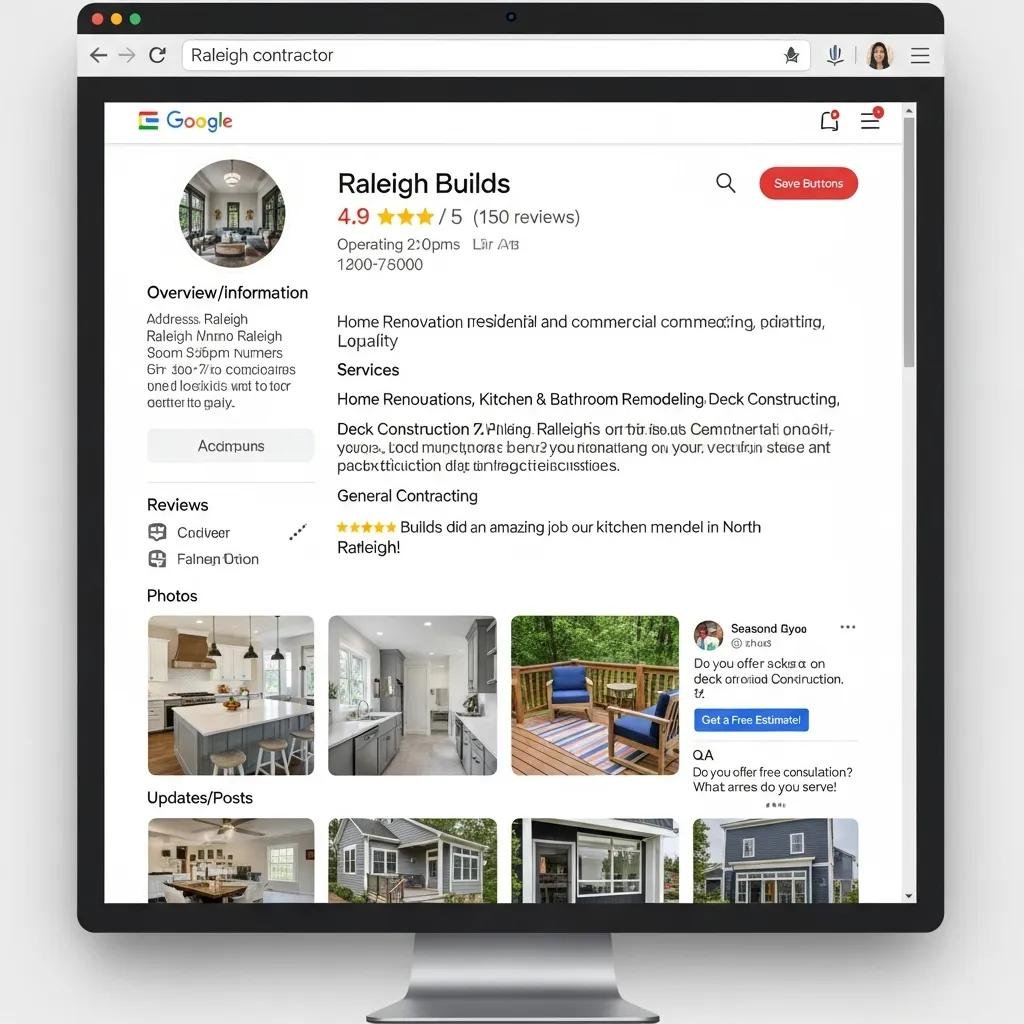
A well-optimized Google Business Profile (GBP) functions as a contractor’s primary storefront in local search, and optimization requires specific, local-first inputs. Begin by selecting precise service categories, adding explicit service areas (Raleigh neighborhoods, nearby towns in NC), and listing distinct service offerings so search algorithms can match queries to your services. Include high-quality local photos and before/after project images with descriptive filenames and captions to improve engagement metrics. Post regularly with project highlights and time-limited offers to signal activity, and monitor Q&A and messages so responses appear promptly and consistently. Implement LocalBusiness schema on your site to reinforce GBP data and ensure NAP consistency across citations; these steps together increase GBP impressions and the likelihood of appearing in the local pack.
Contractors should follow this short GBP checklist to keep profiles competitive:
- Complete Business Info: Select exact categories and list all services and service areas for Raleigh and surrounding NC towns.
- Visual Proof: Upload project before/after photos with descriptive captions and consistent naming conventions.
- Active Signals: Publish weekly posts or offers, answer Q&A, and enable messaging if available.
Following this checklist helps GBP signals remain current and relevant, and the next section addresses how to reliably generate the customer reviews that amplify GBP performance.
What Are Effective Methods to Generate Local Reviews for NC Construction Companies
Generating authentic, local reviews for construction companies depends on timing, ease, and professionalism in request and response workflows. Ask for reviews at the point of completion while the project is fresh, provide a short instruction or QR code on a completion sheet so clients can leave feedback with minimal friction, and send a polite follow-up message that includes a brief template and gratitude for their time. Track reviews in a queue and respond to every review quickly, using responses to highlight scope, dates, and next-step contact details in a professional tone that signals engagement to both users and search engines. Maintain compliance by avoiding incentivization and focusing on service-driven requests; consistent review growth improves local trust signals and can elevate map rankings.
Practical review-request scripts and response patterns streamline execution:
- Request Script (in-person/print): “If you’re happy with our work, a short review about the project helps others and supports our local business. Scan this code to leave feedback — thank you!”
- Follow-up Message: “Thanks again for choosing us. If you can spare a minute, here’s a direct link to share your experience — it really helps our Raleigh-area community.”
- Response Template: “Thank you for the kind words, [Name]. We’re glad the [project type] met your needs. Reach out anytime for future projects.”
These methods increase review volume and quality, and tracking tools ensure timely responses that sustain local engagement and rankings.
After explaining these practical tactics, contractors should consider tools and automation options that reduce manual overhead; the next section examines how AI-powered SEO affects these repetitive tasks.
SEORaleigh, an AI-focused local SEO agency, applies automated workflows to GBP maintenance and local audits by leveraging OTTO AI and a partnership with Search Atlas. Those technologies help automate GBP posting, monitor review inflows, and surface NAP inconsistencies across directories while preserving human oversight for responses and decisions.
Proven Local SEO Strategies for North Carolina Contractors

AI-powered SEO accelerates repetitive analysis and scales content and audit tasks by automating pattern recognition and generating prioritized action lists for contractors. At its core, AI evaluates site health, clusters related keywords by intent, and creates draft content briefs that reflect local intent and competitive gaps, reducing the manual research burden on in-house teams. The mechanism works because AI models can process large crawl outputs, GBP insights, and competitor data to produce ranked recommendations that a human specialist can validate, which shortens the audit-to-implementation cycle and increases optimization cadence. These automation benefits translate into faster technical fixes, more consistent on-page updates, and the ability to maintain topical coverage across multiple service pages for different North Carolina cities.
| AI Feature | Function | Contractor Benefit |
|---|---|---|
| Automated keyword clustering | Groups geo-intent and service queries | Faster content planning for Raleigh neighborhoods |
| Crawl-based prioritization | Ranks technical issues by impact | Faster remediation of high-impact SEO problems |
| Content brief generation | Produces local-focused outlines and meta suggestions | Scales service page and blog production with consistent quality |
These capabilities illustrate how AI reduces manual work while preserving the need for human review and local expertise to ensure factual accuracy and E-E-A-T compliance.
How Can AI Automate On-Page SEO for NC Builders?
AI automates on-page SEO by scanning page-level elements, suggesting optimized titles and meta descriptions with local keywords, and recommending internal linking to strengthen topical clusters. The process typically begins with a crawl that identifies pages missing local signals (city names, service area mentions, or schema), then generates prioritized fixes such as title updates, header adjustments, and schema snippets to add LocalBusiness or Service markup. AI can also propose canonical and pagination fixes when it detects duplicate content patterns, and it can generate A/B copy variants that humans review before publishing. By automating these diagnostic and drafting tasks, AI shortens the time from issue identification to content change and helps builders maintain consistent optimization across dozens of service pages.
These automated recommendations must be validated by local subject-matter experts to ensure that phrasing, service descriptions, and contact practices match actual offerings and regulatory considerations in North Carolina, which preserves credibility and conversion performance.
What Are the Benefits of AI-Driven Content Creation for Contractor Websites?
AI-driven content creation speeds ideation and produces structured drafts for service pages, FAQs, and local guides while preserving a workflow that requires human editorial QA for accuracy and trustworthiness. The key benefits are faster topic coverage across many neighborhoods, consistent inclusion of local keywords and schema suggestions, and the ability to generate initial drafts for case studies and project descriptions that editors then refine with specifics and photos. Workflows that pair AI draft generation with an editorial checklist (verify facts, add project details, include team credentials, and apply LocalBusiness schema) balance scale with E-E-A-T. This approach enables contractors to increase topical depth across service categories like roofing, HVAC, plumbing, and remodeling without sacrificing the local specificity that converts visitors into leads.
Implement content governance rules — such as mandatory project-specific details and photographic proof — to maintain high conversion and trust metrics even as content production scales.
Which Core SEO Practices Drive Lead Generation for NC Contractors?
The core SEO practices that most directly impact leads for contractors in North Carolina are local intent keyword targeting, on-page conversion optimization, technical site health, and authoritative backlinks that drive referral visibility. These practices work together: targeted keywords attract relevant searchers, on-page UX and CTAs convert them, technical SEO ensures pages are discoverable, and links and content marketing build trust that sustains rankings. Prioritization should favor high-intent local queries for immediate lead flow, with medium-term investments in content and links to expand reach. The next subsections outline a step-by-step keyword research process and a prioritized on-page/technical checklist to improve conversions and organic rankings.
High-impact practices can be summarized in a short action list to guide monthly workstreams:
- Local Intent Keyword Targeting: Build service pages for city + service combinations and prioritize neighborhood phrases.
- Technical Health: Fix page speed, mobile UX, and crawl issues that block indexing.
- Conversion Optimization: Add clear CTAs, click-to-call buttons, and request-a-quote forms on service pages.
These steps generate immediate and measurable improvements in organic lead capture, and the following table compares common tactics by complexity and lead impact to help allocate resources.
| Tactic | Implementation Complexity | Lead Impact |
|---|---|---|
| Local citations | Low | Medium – supports GBP relevance |
| Targeted service pages | Medium | High – captures transactional intent |
| Technical fixes (speed/crawl) | Medium-High | High – essential for rankings & UX |
| Backlink outreach | High | Medium-High – builds authority over time |
This comparison helps firms choose between quick wins and longer-term investments that together drive a sustainable lead pipeline.
How to Conduct Keyword Research Targeting North Carolina Construction Services?
Keyword research for North Carolina construction services begins with seed phrases combining service names and city or neighborhood modifiers, then expands through intent filtering and competitor gap analysis to surface high-conversion long-tail opportunities. Use search console query data to identify existing queries already bringing traffic, then layer third-party tool insights to quantify volume and difficulty. Prioritize transactional and local-intent keywords such as service + city or “service near [neighborhood]” and create a mapping that assigns each high-priority keyword to a single service page or project case study to avoid cannibalization. Competitor SERP analysis reveals featured snippets and local pack occupants to model content depth and schema usage, while clustering similar queries ensures you cover semantic variations without creating redundant pages.
Implement this process as a monthly cadence: identify gaps, draft or update pages, and measure ranks and conversions to refine targeting across Raleigh and surrounding NC markets.
What On-Page and Technical SEO Techniques Improve Contractor Website Rankings?
On-page and technical techniques for contractor sites include optimizing title tags and headers with geo-intent, compressing and lazy-loading images with descriptive alt text, implementing LocalBusiness and Service schema, and ensuring fast mobile-first performance through caching and resource optimization. Prioritize quick wins such as fixing broken links, updating meta descriptions to include city modifiers, and adding clear click-to-call buttons for mobile visitors. Advanced tasks include structured data implementation for projects and reviews, canonicalization to address duplicate content, and systematic internal linking to strengthen service clusters. Monitoring via Google Search Console and page-speed tools helps validate fixes and measure improvements, and iterative deployment of changes with A/B testing can reveal which on-page elements most improve conversions.
Use this prioritized checklist to schedule technical and content work monthly, starting with the highest-impact items that most directly affect discoverability and user experience.
How Can Contractors Build Authority Through Link Building and Content Marketing in NC?
Authority for North Carolina contractors grows from link-building tactics that emphasize local relevance and industry relationships combined with content marketing that demonstrates expertise through project case studies and local resources. Links from local news sites, trade associations, suppliers, and community organizations carry geographic relevance that search engines use to assess local authority. Content types that earn links include in-depth project pages with rich media, downloadable local guides, and data-driven resources that solve common homeowner problems. When combined with outreach templates and relationship development, these strategies create continuing referral traffic and strengthen topical authority that helps both organic rankings and conversion rates. The next sections list effective link tactics and ways content converts readers into leads.
- Claim and maintain listings in local and trade-specific directories to secure foundational citations.
- Produce link-worthy project case studies and local neighborhood guides that local sites and suppliers will reference.
- Outreach to suppliers, trade associations, and local media with tailored pitches highlighting noteworthy projects or community involvement.
What Are Effective Link Building Strategies for North Carolina Construction Firms?
Effective link building for NC construction firms prioritizes local partnerships, industry directories, and resource-driven content that naturally attracts links. Start by claiming listings on reputable local directories and trade association pages to secure baseline citations. Create linkable assets such as detailed project case studies with unique data (timelines, materials, and local challenges) and promote those assets to suppliers and local media. Sponsor or participate in community events or trade shows and secure mention pages from organizers; these local signals reinforce geographic relevance to search engines. Outreach should be personalized and include specific value propositions, such as offering expert commentary or project photography, and track success with a CRM so you can scale repeatable tactics.
Use medium-difficulty tactics like supplier outreach and PR to secure higher-authority backlinks while maintaining ongoing citation hygiene for consistent local relevance.
How Does Content Marketing Generate Leads for NC Contractors?
Content marketing converts visitors into leads by aligning content types with stages of the homeowner’s decision process, such as awareness (how-to articles and local guides), consideration (project case studies and comparison pages), and decision (detailed service pages and clear CTAs). Service pages should include pricing cues, process descriptions, and trust signals like project photos and review excerpts to reduce friction at contact points. Local guides and FAQ pages draw long-tail organic traffic and can be used to capture emails or encourage quote requests via prominent CTAs. Promote content through GBP posts, local social channels, and outreach to local sites to amplify reach; combining targeted content with conversion-focused page design yields measurable increases in inbound leads.
Measure content effectiveness by tracking assisted conversions, lead volume by content source, and on-page conversion rates, and update high-performing pages quarterly to maintain relevance and rankings.
How to Measure SEO Success and Stay Ahead in the North Carolina Contractor Market?
Measuring SEO success for contractors requires tracking local KPIs such as local pack rank, GBP impressions and actions (calls, direction requests), organic leads, and conversion rates from service pages. Use a combination of Google Search Console for query insights, GBP dashboard for local engagement metrics, and Google Analytics 4 for session behavior and goal tracking. Establish a reporting cadence (monthly KPI dashboard with quarterly strategy reviews) and map each KPI to tactical actions — for example, low GBP clicks may trigger a review of photos and posts, while declining organic leads could prompt a technical audit. Regular content audits and link profile reviews maintain topical freshness and authority, and preparing for future shifts like AI-driven search and voice queries ensures long-term competitiveness.
| KPI | Measurement Tool | Reporting Cadence |
|---|---|---|
| Local pack rank | Rank tracking / manual checks | Monthly |
| GBP views & actions | Google Business Profile dashboard | Weekly to monthly |
| Organic leads (form/call) | GA4 + call tracking | Monthly |
| Technical issues | Site crawl tools / GSC | Monthly or after major changes |
This mapping clarifies which tools measure which outcomes and sets a practical monitoring rhythm for small and mid-size contractor teams.
Which KPIs and Tools Track Local SEO Performance for NC Contractors?
Key KPIs for local contractor SEO include GBP actions (calls, website clicks, direction requests), local pack positions for priority keywords, organic lead volume, and page-level conversion rates on service pages. Google Search Console provides query-level visibility and indexing signals, Google Business Profile shows local engagement, and GA4 links sessions to goal completions to quantify leads. Contractors can augment these with dedicated rank trackers and backlink monitoring to measure authority growth. Set specific targets (e.g., increase GBP calls by X% in 90 days) and use weekly snapshots to detect regressions quickly so tactical fixes can be applied before losses compound.
A consistent cadence of data review plus prioritized action items closes the loop between measurement and improvement, sustaining lead growth in competitive North Carolina markets.
What Future SEO Trends Should NC Contractors Prepare For?
Emerging SEO trends contractors should prepare for include increased AI-driven search result generation, stronger emphasis on E-E-A-T and demonstrable authoritativeness, and growing importance of voice and mobile-local queries. Prepare by maintaining factual, project-specific case studies and author or company credentials that support E-E-A-T, optimizing content for natural language queries and featured snippet opportunities, and ensuring mobile speed and click-to-call experiences are exceptional. Regularly audit content for factual accuracy and update timelines quarterly as local market conditions and technologies evolve. These proactive steps help contractors remain discoverable and competitive as search engines and user behaviors evolve.
Plan quarterly reviews tied to tactical roadmaps so you can test new formats (voice-optimized FAQs, AI-assisted content with human QA) and measure impact before scaling changes across service pages.
SEORaleigh offers a free website analysis and AI-audit option that demonstrates how automation and human review can work together to identify high-impact fixes for local contractors. Contractors interested in an AI-assisted site audit can request an analysis to prioritize GBP issues, technical tasks, and content opportunities specific to North Carolina markets.